
English
Get your handwriting back as text you can search
A written page is rarely a clean run of sentences. Someone adds a line in the margin and drags it in with an arrow, crosses out half a clause but leaves it readable, or hands the notebook to a colleague who writes nothing like they do. Evidano reads the page as a page: it follows insertions to where they belong, keeps deletions apart from the text that replaced them, and shows you every reading beside the image.
Sample pages
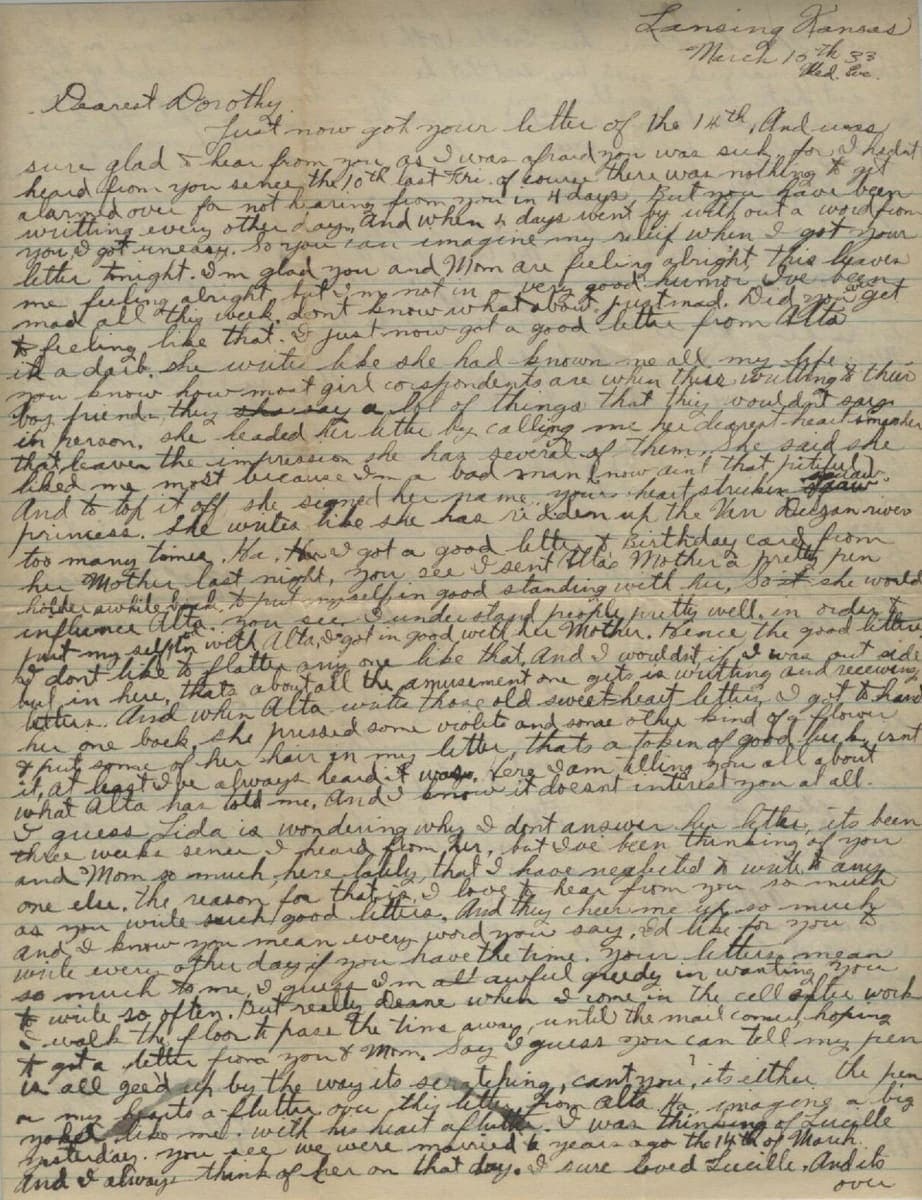
Source · Public domain · Public domain in the United States, copyright not renewed
Evidano Transcription
Lansing Kansas
March 15th 33
Wed. Eve.
Dearest Dorothy.
Just now got your letter of the 14th, And was
sure glad to hear from you, as I was afraid you was sick, for I hadnt
heard from you sence the 10th last Fri. of course there was nothing to get
alarmed over for not hearing from you in 4 days, But you have been
writting every other day, And when 4 days went by without a word from
you, I got uneasy. so you can imagine my relief when I got your
letter tonight. I'm glad you and Mom are feeling alright, this leaves
me feeling alright, but I'm not in a very good humor, I've been
mad all this week. don't know what about. just mad. Did you get
to feeling like that. I just now got a good letter from Alta
its a darb. she writes like she had known me all my life,
you know how most girl corespondents are when their writting to their
boy friends, they [cancelled: the] say a lot of things that they wouldn't say
in person, she headed her letter by calling me her dearest heart smasher
that leaves the impression she has several of them, she said she
liked me most because I'm a bad man (now aint that pitiful).
And to top it off she signed her name. your heart stricken [cancelled: squaw]
princess. she writes like she has ridden up the Ver Degris river
too many times. Ha. Ha. I got a good letter & Birthday card from
her Mother last night, you see I sent Altas Mother a pretty pen
holder awhile back to put myself in good standing with her, so that she would
influence Alta. you see I understand people pretty well, in order to
put my self in with Alta, I got in good with her Mother. Hence the good letters
I don't like to flatter any one like that, And I wouldnt if I was out side
but in here, thats about all the amusement one gets is writting and receiving
letters. And when Alta writes those old sweet heart letters, I got to hand
her one back, she pressed some violets and some other kind of a flower
& put some of her hair in my letter, thats a token of good luck, isnt
it, at least I've always heard it was. Here I am telling you all about
what Alta has told me, And I know it doesnt interest you at all.
I guess Lida is wondering why I dont answer her letter, its been
three weeks sence I heard from her, but I've been thinking of you
and Mom so much here lately, that I have neglected to write to any
one else. the reason for that is, I love to hear from you so much
as you write such good letters. And they cheer me up so much
And I know you mean every word you say, I'd like for you to
write every other day if you have the time. your letters mean
so much to me, I guess I'm an awful greedy in wanting you
to write so often. But really Deane when I come in the cell after work
I walk the floor to pass the time away, until the mail comes, hoping
to get a letter from you & Mom. Say I guess you can tell my pen
is all geed up by the way its scratching, cant you, its either the pen
or my hearts a-flutter over this letter from Alta Ha. imagine a big
yokel like me. with his heart aflutter. I was thinking of Lucille
yesterday. you see we were married 6 years ago the 14th of March.
And I always think of her on that day. I sure loved Lucille. And its
over
Generated by Evidano’s advanced model; not yet checked against a published edition.
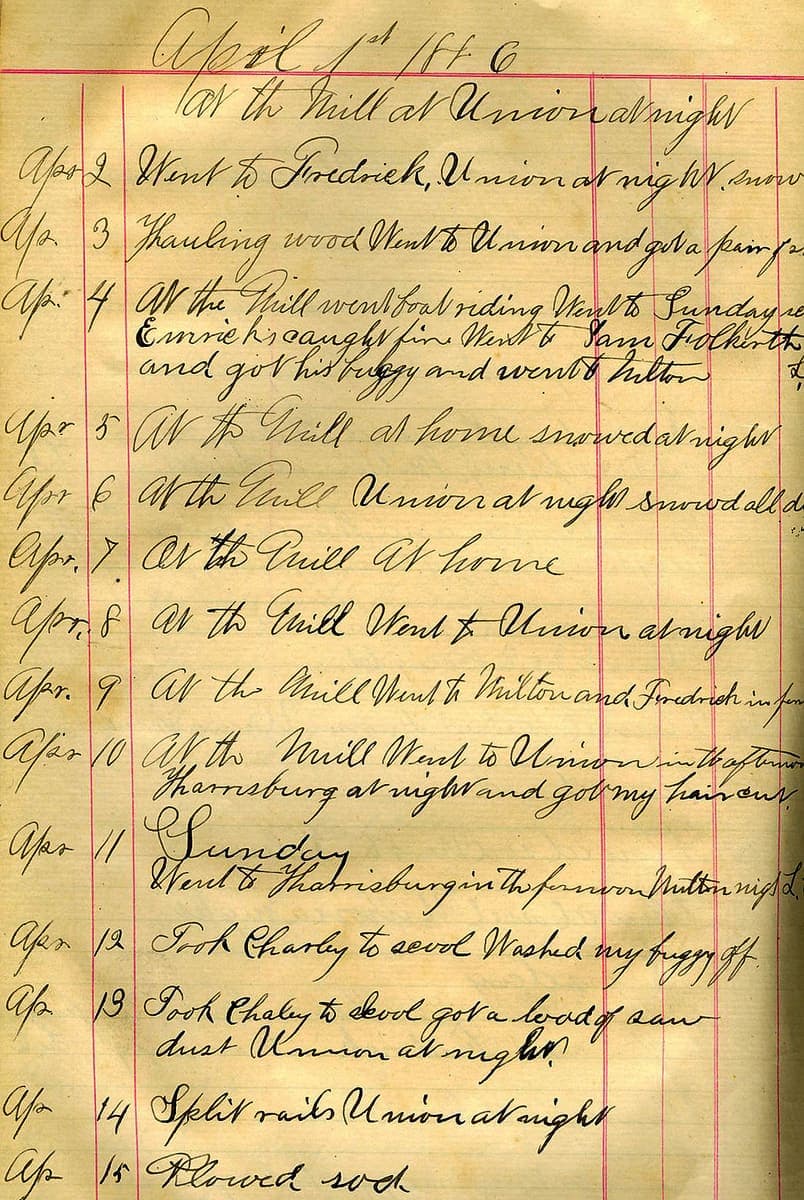
Source · CC BY 2.0 · Photograph by Don O’Brien, Piketon, Ohio
Evidano Transcription
| April 1st 1886 | ||
|---|---|---|
| At th Mill at Union at night | ||
| Apr | 2 | Went to Fredrick, Union at night snow |
| Ap. | 3 | Hauling wood Went to Union and got a pair pa |
| Ap. | 4 | At the Mill went boat riding Went to Sunday sc Emrichs caught fire Went to Sam Folkerth and got his buggy and went to Milton L |
| Apr | 5 | At th Mill at home snowed at night |
| Apr | 6 | At th Mill Union at night snowd all d |
| Apr. | 7 | At th Mill At home |
| Apr. | 8 | At th Mill Went to Union at night |
| Apr. | 9 | At th Mill Went to Milton and Fredrick in for |
| Apr | 10 | At th Mill Went to Union in th afternoo Harrisburg at night and got my hair cut |
| Apr | 11 | Sunday Went to Harrisburg in th forenoon Milton nigh L |
| Apr | 12 | Took Charley to scool Washed my buggy off |
| Ap | 13 | Took Chaley to scool got a load of saw dust Union at night |
| Ap | 14 | Split rails Union at night |
| Ap | 15 | Plowed sod |
Generated by Evidano’s advanced model; not yet checked against a published edition.
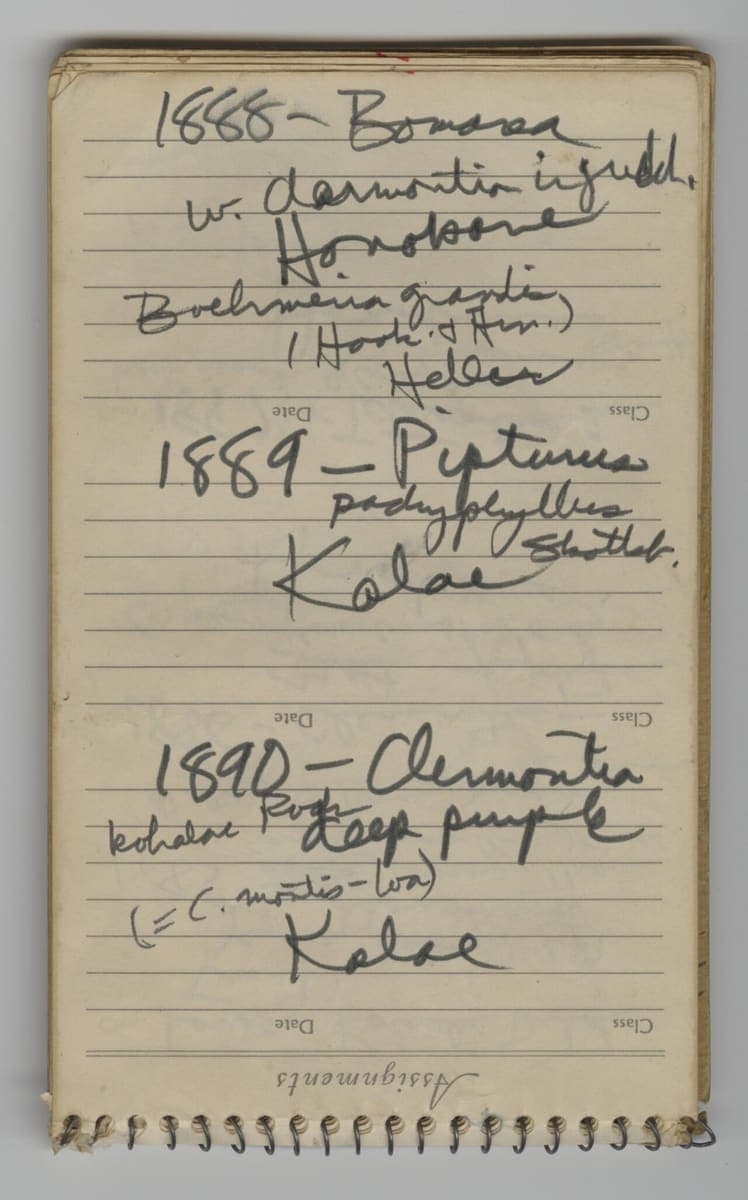
Botanical Research Institute of Texas, via the Digital Public Library of America, 1966 · Source · CC BY 4.0 · Sherwin John Carlquist (1930–2021)
Evidano Transcription
1888 - Bomarea
w. clermontia in gulch.
Honohono
Boehmeria grandis
(Hook. & Arn.)
Heller
1889 - Pipturus
pachyphyllus
Skottsb.
Kalae
1890 - Clermontia
kohalae Rock deep purple
(= C. montis-loa)
Kalae
Generated by Evidano’s advanced model; not yet checked against a published edition.
Evidano Transcription
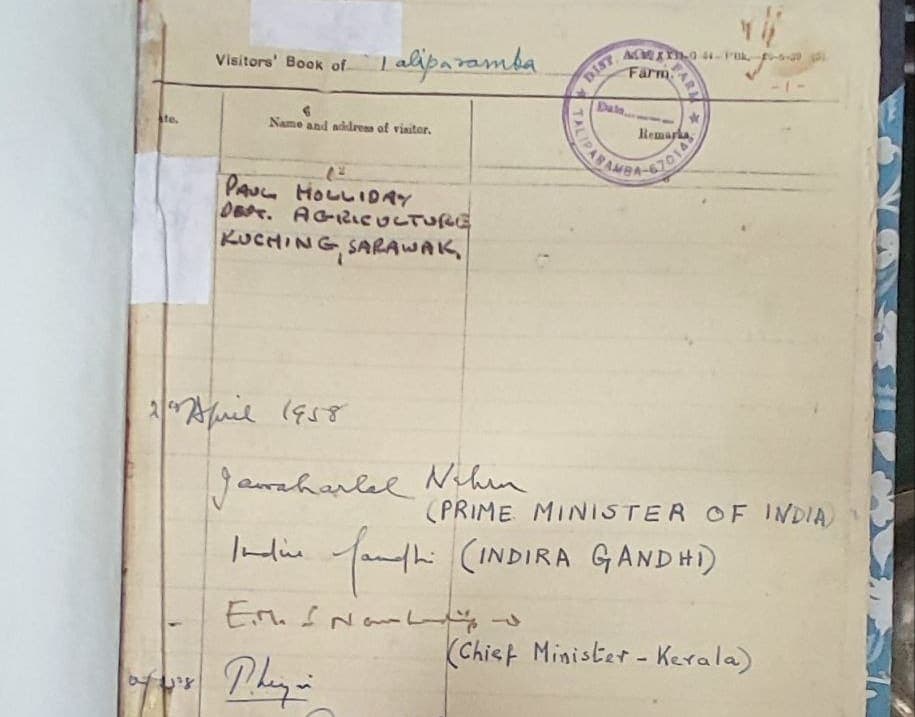
Visitors' Book of Taliparamba Farm.
[stamp: DIST. AGRL. FARM, TALIPARAMBA-670141] AGR.XXII-G 44 - P Bk. - 10-5-39 - 151
✓
- 1 -
| Date. | Name and address of visitor. | Remarks. |
|---|---|---|
| PAUL HOLLIDAY DEPT. AGRICULTURE KUCHING, SARAWAK | ||
| 29th April 1958 | ||
| Jawaharlal Nehru (PRIME MINISTER OF INDIA) | ||
| Indira Gandhi (INDIRA GANDHI) | ||
| - | E M S Namboodiripad (Chief Minister - Kerala) | |
| 29/4/58 | [illegible] |
Generated by Evidano’s advanced model; not yet checked against a published edition.
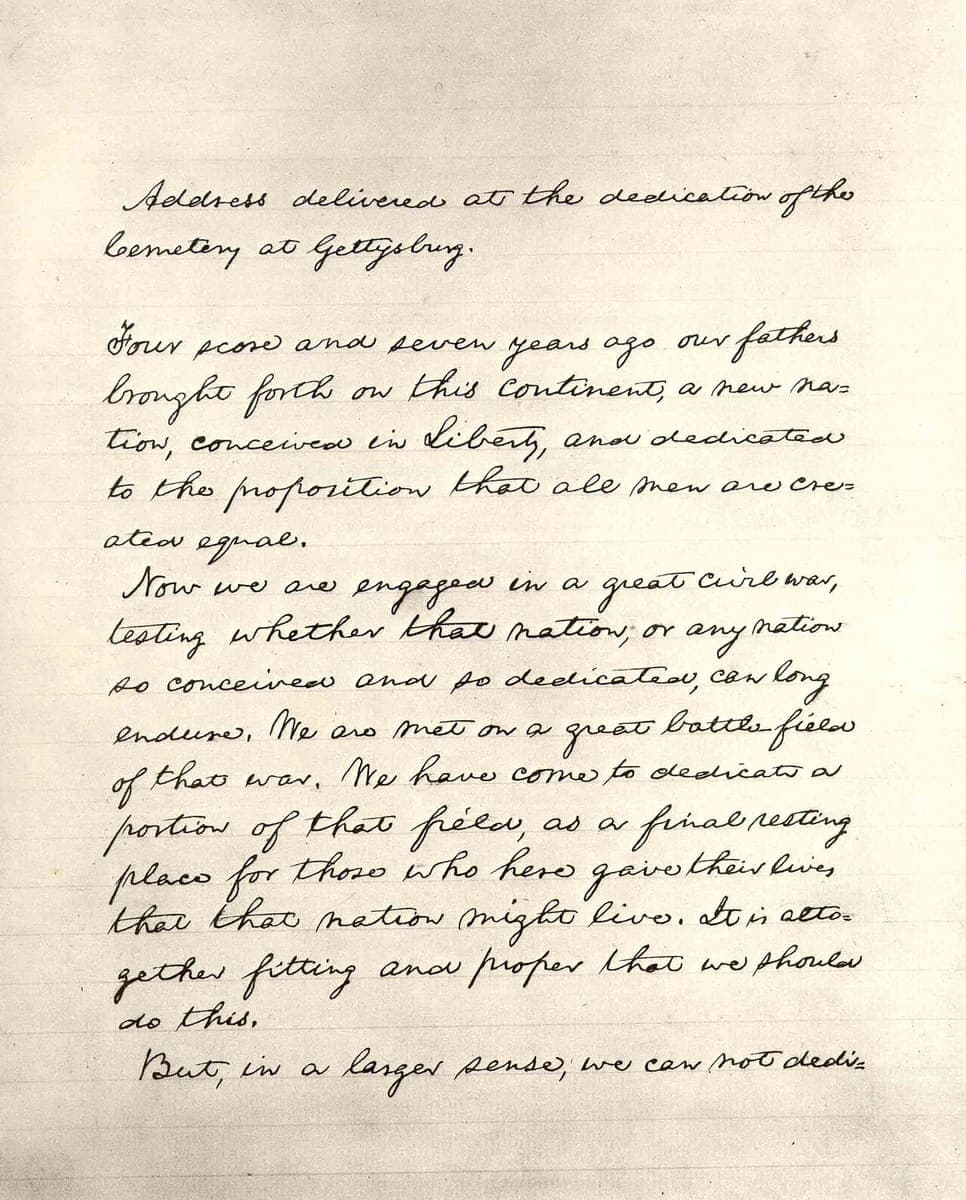
Evidano Transcription
The whole leaf, from the English Wikisource proofread transcription of this exact image. The editors run the text as continuous paragraphs rather than following Lincoln’s line breaks, and drop his “=” line-end marks; the leaf ends on the first half of a divided word, given here as it appears with the completion the transcription supplies.
Address delivered at the dedication of the cemetery at Gettysburg.

Four score and seven years ago our fathers brought forth, on this continent, a new nation, conceived in Liberty, and dedicated to the proposition that all men are created equal.

Now we are engaged in a great civil war, testing whether that nation, or any nation so conceived and so dedicated, can long endure. We are met on a great battle-field of that war. We have come to dedicate a portion of that field, as a final resting place for those who here gave their lives that that nation might live. It is altogether fitting and proper that we should do this.

But, in a larger sense, we can not dedi[cate]
Source: Gettysburg Address (Bliss copy), proofread page 1, English Wikisource (Public domain).
What a handwritten page actually contains
Everyday handwriting sits somewhere between joined cursive and printed capitals, and most people use both on the same page — capitals for a heading or a name, a fast loop for the body, print for a number they want to be sure of later. Speed flattens letters: a, o and u lose their bowls, n, m, u and w become a run of minims, e closes up, and the crossbar of a t drifts onto the following letter. Word endings shrink to a flick, so -ing, -tion and -ment are often a rise and a tail rather than letters. None of this is careless; it is simply a different alphabet from printed type, and a reader recognises it from context and from the writer’s own habits rather than shape by shape.
Structure on a handwritten page is spatial. Dashes and dots stand in for bullets, indentation marks a sub-point, a box or a circle marks something to come back to, a ticked item is done, an underline or a double underline carries emphasis a keyboard would give to bold. Additions arrive after the fact: a caret with a few words above the line, a sentence up the left margin with an arrow to the place it belongs, a note squeezed round the punch holes, a second thought on the facing page. Cancellations range from a single stroke that leaves the words perfectly legible to a scribble that destroys them, and a writer will sometimes overwrite one word on top of another rather than cross out at all.
The physical page matters as much as the hand. Ruled and squared paper, printed column headings, punch holes, a spiral binding, an office stamp, a second person’s ink in the margin, a photocopy’s grey background: each is furniture a transcription has to recognise and either set aside or record separately. Most handwritten material now arrives as a phone photograph rather than a flatbed scan, which adds curl at the gutter, the photographer’s shadow, keystone distortion and sometimes a thumb.
Why ordinary OCR struggles here
The same writer, several alphabets
Optical character recognition matches shapes against printed type, and handwriting has no fixed shapes to match. One person’s r can look like a v at the start of a word and a wave in the middle; their capital I and their figure 1 may be the same stroke. Reading depends on the sense of the sentence and on what the writer did three lines earlier — exactly what a shape-matching engine cannot use.
Text that does not run top to bottom
A caret two words wide, an arrow curving from the margin into the middle of a paragraph, a numbered note at the foot keyed to a superscript, a continuation written sideways up the edge of the sheet: all of these belong in the middle of the text, not at the end of it. Layout engines built for printed columns put them wherever they happen to sit on the page.
Deletions that are still readable
A struck-through phrase is not noise. Sometimes the deleted wording is the point — a draft letter, a set of minutes amended in the meeting, a figure corrected after a recount. The transcription needs to say what was cancelled and what replaced it, rather than silently keeping one and discarding the other, or worse, running the two together into a sentence nobody wrote.
Photographs of paper, not scans of it
A page shot on a phone is lit from one side, bent along the binding and often taken at an angle, so the lines converge. Ruled lines get read as strikethrough, a shadow in the gutter as an ink blot, bleed-through from thin paper as faint extra words. These are properties of the image, not characters in the text.
Who works with this material
Family historians and archive volunteers
Boxes of letters, diaries and account books get read once and forgotten because nothing in them can be searched. A transcription that keeps names, places and dates as written turns a shoebox into something you can query, with the judgement calls — a doubtful surname, an ambiguous figure — flagged for a person to settle.
Researchers with notebooks and lab books
Field notes, dig diaries and bench books hold data that never reached the published paper: collection numbers, weather, coordinates, the specimen that was discarded. In text they can be joined to the specimen or dataset record, and pencil abbreviations expanded the same way across a whole notebook.
Anyone who takes notes on paper
Meeting notes, interview notes, a page of ideas with three arrows on it. What matters is not scholarly precision but that actions, names and numbers come out in the right order and nothing added later lands at the bottom of the file.
Community heritage and oral history projects
Visitors’ books, minute books and correspondence held by small museums are photographed rather than scanned, by volunteers, in whatever light is going. A transcription that copes with that and marks what it could not read is more useful than one that guesses.
Getting the best transcription
Photograph the page as flatly as you can
Fill the frame with the sheet, shoot from directly above, and take the light from the side you are not standing on so your shadow stays out of the picture. For a bound book, press the page flat near the gutter and shoot one page at a time; a curved line of writing is harder to read than a dim one.
Say what to do with insertions and deletions
Decide whether cancelled words should be kept, marked or dropped, and whether a margin addition moves to its caret or stays where it sits with a note. Stating the rule once means the whole notebook is treated alike and you can change your mind later without re-reading it.
Give the model something it can calibrate against
If there is one page you have already read yourself, run that first and compare. Names, places, technical vocabulary and private abbreviations are where handwriting goes wrong; supplying a short list of the people, places and terms involved removes most of those errors on the pages that follow.
Check numbers, names and dates before anything else
Prose can be repaired later from context, but a wrong digit in a measurement or a year is invisible once the image is closed. Read those against the page first and skim the rest.
Frequently asked questions
- Can it read joined-up cursive, or only neat printing?
- Both, including the mixture most people write. Joined hands are read as words rather than as separate letters, which is why a fast scrawl often comes out better than you expect and an unfamiliar proper name often comes out worse. Where a word genuinely cannot be resolved it is marked rather than invented.
- What happens to words that are crossed out or written over?
- You choose. The default is to give the final text and record the cancelled words separately, so a draft can be read as it stands or as it was first written. Where one word is written on top of another and both are still visible, the transcription says so instead of picking one silently.
- The page was written by two people. Will that be obvious?
- Changes of hand, pen or ink colour can be marked as they occur, so a note added later in a different biro is not merged into the original text. This matters most on registers, minute books and forms that were filled in by one person and checked by another.
- Where do arrows and margin notes end up?
- An arrow or a caret is treated as an instruction about reading order. The inserted words are placed where the writer pointed them, and the transcription can note that they came from the margin so you can see what the page looked like before the addition.
- Is a phone photograph good enough, or do I need a scanner?
- A phone photograph is usually enough if the writing fills the frame and is in focus. Resolution matters less than sharpness and even lighting: a well-lit photo of a single page beats a hurried scan of a whole open book. Skew and mild curvature are handled; a blurred shot is not.
Related scripts and pages
Turn a stack of handwritten pages into text
Upload a letter, a notebook page or a photographed register, choose Handwritten Content, and check the first page line by line before you run the rest.