
English
Write up the board before it gets wiped
A whiteboard at the end of a session is a diagram, a list, three colours of pen and a dozen half-erased earlier ideas, photographed at an angle with the ceiling lights burning a white hole through the middle. What matters is not only the words but which box an arrow points at, which sticky note sits in which column, and how many dots a proposal collected. Evidano writes the board up as structure — clusters, headings, connections and notes — rather than as one long line of fragments.
Sample pages
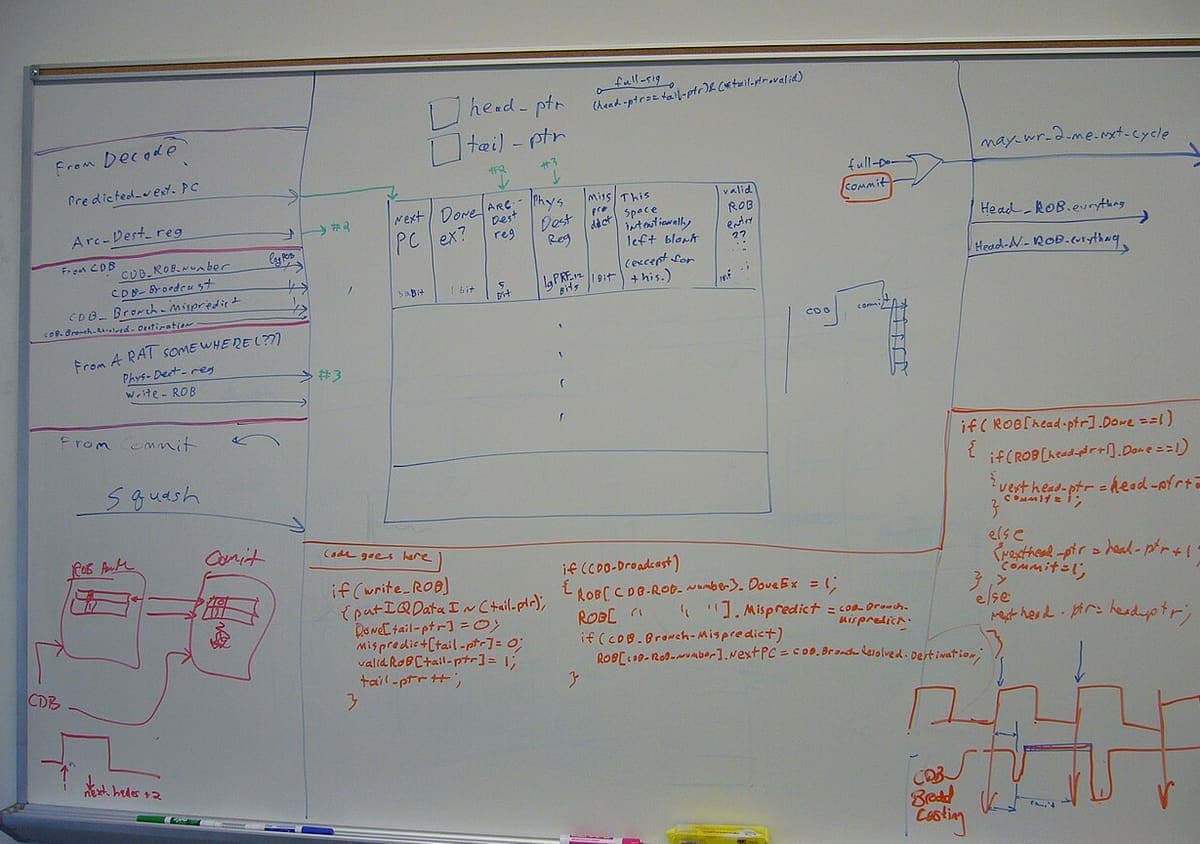
Source · Public domain · Photograph by Wikimedia Commons user Lostiguana
Evidano Transcription
From Decode
Predicted_Next_PC ----------------------------------------------------->
Arc-Dest-reg ----------------------------------------------------------> #2
From CDB
CDB_ROB_number \lg ROB/ ----------------------------------------------->
CDB-Broadcast --------------------------------------------------------->
CDB_Branch_Mispredict ------------------------------------------------->
CDB_Branch_Resolved_Destination --------------------------------------->
From A RAT SOMEWHERE(??)
Phys-Dest-reg ---------------------------------------------------------> #3
Write-ROB ------------------------------------------------------------->
From commit <-------------------------------------------------------------
Squash ---------------------------------------------------------------->
ROB Arch Comit
CDB
next_head +2
[ ] head-ptr full-sig
[ ] tail-ptr (head-ptr == tail-ptr) & (tail-ptr.valid)
#2 #3
| Next PC 32 Bit | Done ex? 1 bit | ARC Dest reg 5 Bit | Phys Dest Reg lg PRF_sz bits | Miss pre dict 1 bit | This space intentionally left blank (except for this.) | valid ROB entry ?? 1 bit |
|---|
[Code goes here]
if (write_ROB)
{ put IQ Data In ~> (tail-ptr);
Done[tail-ptr] = 0;
mispredict[tail-ptr] = 0;
validROB[tail-ptr] = 1;
tail-ptr++;
}
if (CDB-Broadcast)
{ ROB[CDB-ROB_number].DoneEx = 1;
ROB[ " " ].Mispredict = CDB-Branch-
mispredict;
if (CDB-Branch-Mispredict)
ROB[CDB-ROB_number].NextPC = CDB-Branch-Resolved-Destination;
}
full-sig
commit
may-wr-2-me-nxt-cycle ->
Head_ROB.everything ->
Head-N-ROB.everything ->
CDB commit
if (ROB[head-ptr].Done == 1)
{
if (ROB[head-ptr+1].Done == 1)
{ next head-ptr = head-ptr+2
commit = 1;
}
else
{ next head-ptr = head-ptr + 1;
commit = 1;
}
}
else
next head-ptr = head-ptr;
CDB
Broad
Casting
Generated by Evidano’s advanced model; not yet checked against a published edition.
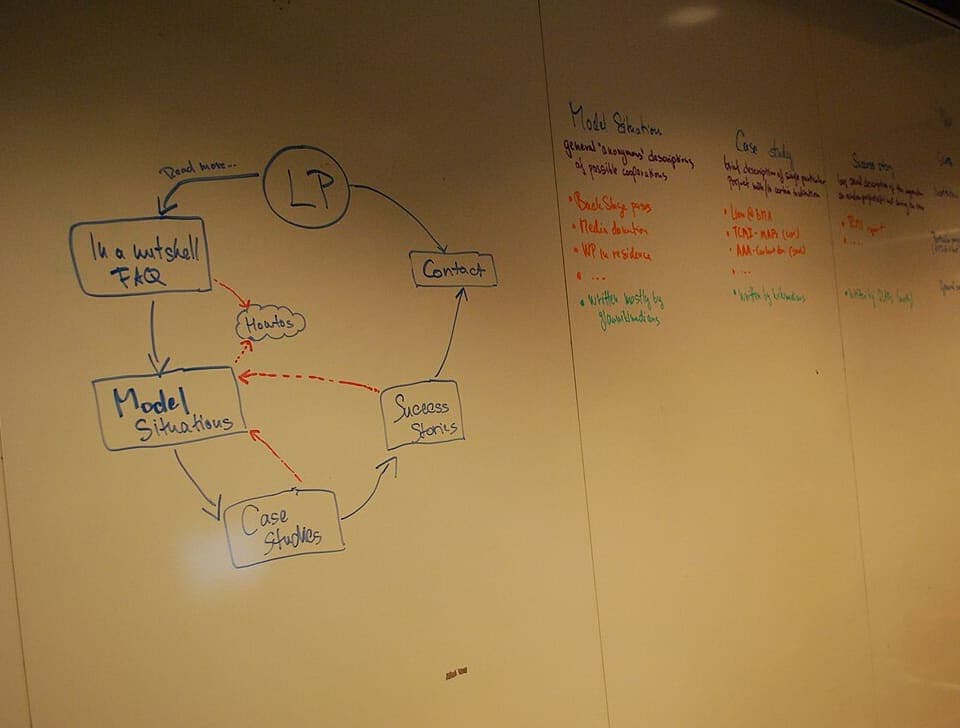
Source · CC BY-SA 3.0 · Photograph by Wikimedia Commons user Thelmadatter
Evidano Transcription
Read more...
LP
In a nutshell
FAQ
Howtos
Model
Situations
Contact
Case
Studies
Success
Stories
Model Situations
general "anonymous" descriptions
of possible cooperations
• Back Stage pass
• Media donation
• WP in residence
• ...
• Written mostly by
glams/wikimedians
Case study
brief description of single particular
project with/in certain institution
• Liam @ BMA
• TCMI - MAPA (uk)
• AAA - Content don (swe)
• ...
• Written by wikimedians
Success story
long detailed description of the cooperation
[illegible]
• TCMI report
• ...
• Written by GLAMs (only)
[illegible: a fourth column is cut off at the right edge of the board]
Generated by Evidano’s advanced model; not yet checked against a published edition.
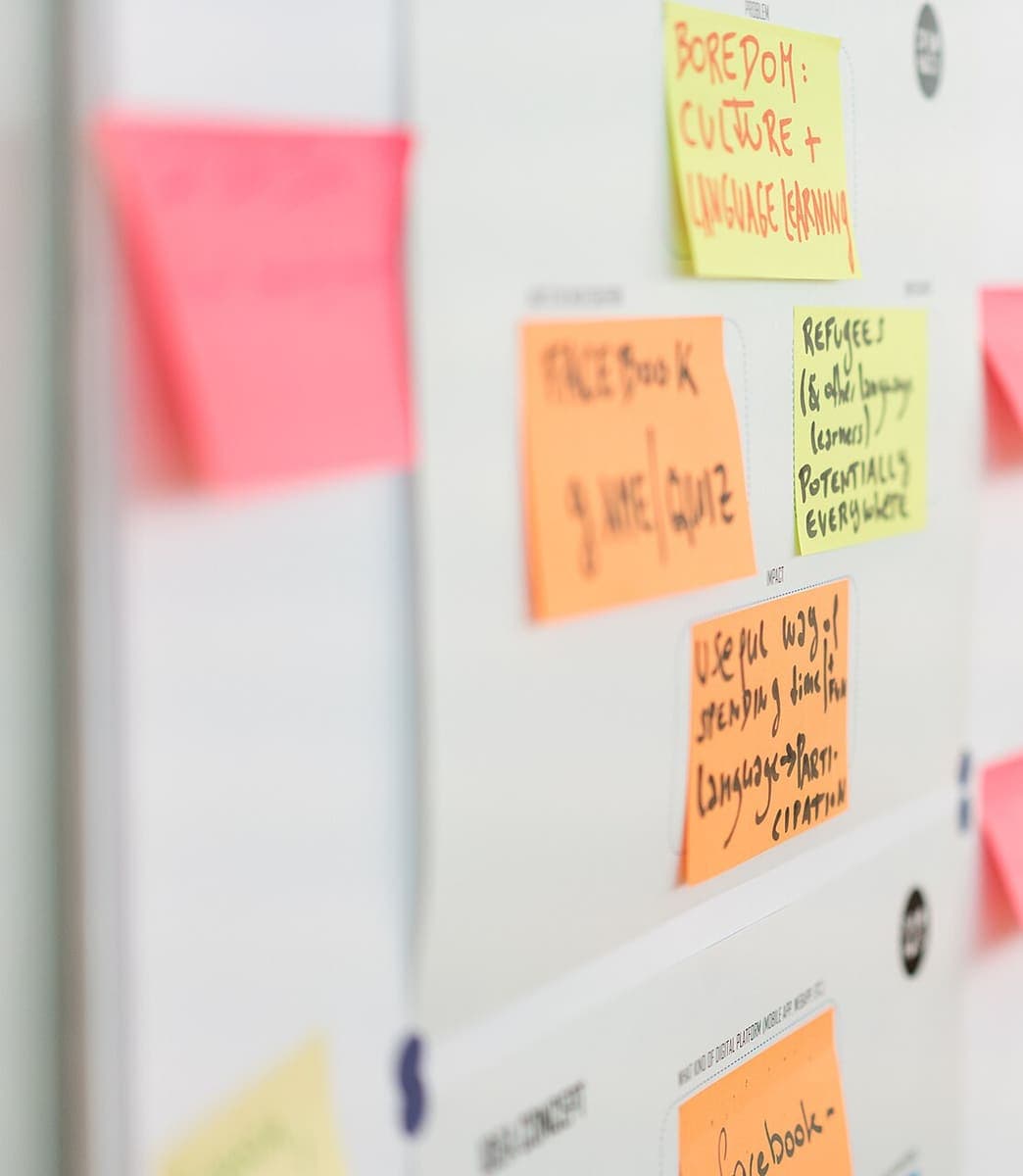
Evidano Transcription
PROBLEM
BOREDOM:
CULTURE +
LANGUAGE LEARNING
[illegible]
GAME | QUIZ
REFUGEES
(& other language
learners)
POTENTIALLY
EVERYWHERE
IMPACT
Useful way of
spending time / fun
language -> PARTI-
CIPATION
IDEA CONCEPT
WHAT KIND OF DIGITAL PLATFORM (MOBILE APP, WEBAPP, ETC)
Facebook -
Facebook -
Generated by Evidano’s advanced model; not yet checked against a published edition.
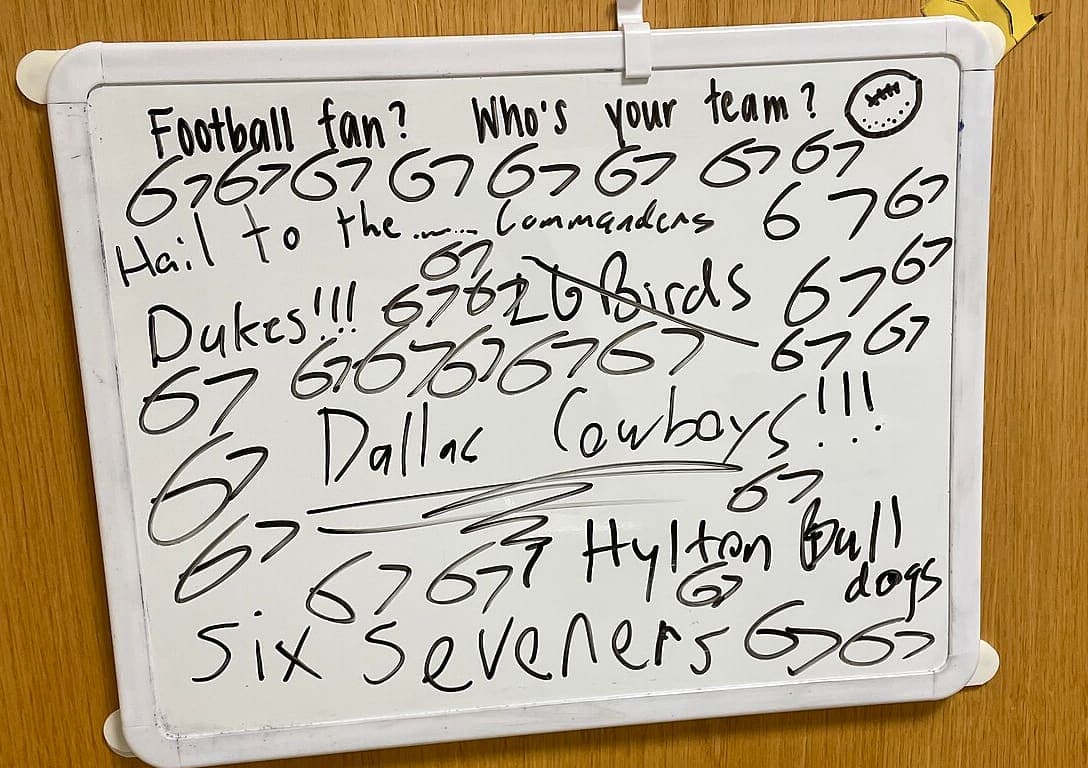
Source · CC0 1.0 · Photograph by Wikimedia Commons user GuiltyGearFan37
Evidano Transcription
Football fan? Who's your team?
67676767 67 67 67 6767
Hail to the...... Commanders 6767
Dukes!!! 6767 [cancelled: 26 Birds] 6767
[67 written small above "6767"]
67 676767676767 6767
67 Dallas Cowboys!!!
67 67 67
67 6767 Hylton Bull dogs
[67 written small under "Hylton"]
Six Seveners 6767
Generated by Evidano’s advanced model; not yet checked against a published edition.
How a board carries meaning
Workshop output looks nothing like a document. A whiteboard is usually split into zones by a drawn line or simply by space: a parking lot in one corner, actions in another, a sketch in the middle. Inside a zone the writing is a mixture of short labels, arrows, boxes, brackets, ticks, crosses, question marks and numbers used as rankings. Colour is a system rather than decoration — one pen for the problem and another for the solution, red for blockers, a highlighter for whatever was agreed. A flip chart sheet does the same in portrait, is torn off and stuck to a wall, and often carries the date and the facilitator’s heading at the top.
Sticky notes add a second grammar. Each note is one idea, written large in capitals with a marker, and its meaning depends on where it has been put: a column on a kanban board, a row on a retrospective grid of what went well and what did not, a cluster given a heading after the fact, or a position on an axis of effort against value. Dot votes appear as coloured spots in the corner of a note; initials in another corner say who wrote it. Notes overlap, curl at the edges, fall off, and get moved between columns, so the photograph records one moment in an argument rather than a settled result.
The physical conditions are unhelpful. Whiteboards are glossy and reflect windows and light fittings; the picture is usually taken from the side of the room, so the board is a trapezium and the far end is smaller and dimmer than the near end. Marker ink is thin, dry-erase writing is fast and irregular, and yesterday’s session is still faintly visible under today’s. On a wall of notes the camera can only focus on part of the surface, so the far notes soften into colour. Half the work of reading a board is deciding what is still live and what is a ghost.
Why ordinary OCR struggles here
Position is the sentence
Two words in a box joined by an arrow to another box is a statement, and a note in the third column of a grid means something different from the same note in the first. Text pulled off the board without its geometry loses the argument entirely, which is why the layout has to be described as well as the words.
Erased, overwritten and crossed-out
A board carries the shadow of what was wiped, a word rubbed out and rewritten on top, and items struck through when they were rejected or done. Reading the ghost as live text puts abandoned ideas into your minutes; ignoring the crossing-out records a decision that was reversed.
Glare, angle and focus
Ceiling lights make a white patch that erases a whole line, the board narrows towards the far edge because the photograph was taken from a chair, and a wall of sticky notes cannot be in focus from end to end. These are properties of the photograph, not the handwriting, and they set a hard limit on what can honestly be read.
Marker handwriting at speed
Board writing is large, fast and unjoined, often in capitals, with letters formed differently by every person who held the pen. Abbreviations are invented on the spot — a product name shortened to two letters, a metric written as an arrow — and only someone who was in the room can expand them with confidence.
Who works with this material
Facilitators and workshop leads
The write-up is the deliverable, and it is usually done the same evening from photographs. Getting the notes into a document with their clusters and headings intact turns two hours of typing into a review, and nothing is lost when the room is reset.
Product and delivery teams
Retrospective and planning boards hold actions that need to reach a tracker. Each note becomes an item with its column, its votes and any owner’s initials, which is enough to raise a ticket without inventing detail that was never on the wall.
Researchers running participatory sessions
Co-design and community workshops produce walls of notes that have to be coded and analysed. Keeping each note as a separate unit, with the group it belonged to, is what makes that analysis possible; merging them into a paragraph destroys the data.
Engineering and design teams
Architecture sketches, state diagrams and rough schemas start life on a board. A transcript that keeps labels attached to shapes, and reports the arrows as relationships, gives you a starting point for a proper diagram rather than a fresh sheet of paper.
Getting the best transcription
Photograph the board in sections
Stand square to the surface and take several overlapping shots rather than one wide one from the corner. Turn off the flash, move so the light fitting is not reflected back at you, and take a final wide frame so the sections can be put back in order.
Say what the colours and columns mean
Tell the model that red is a blocker, that the three columns are Start, Stop and Continue, or that dots are votes. A board is a private notation, and a sentence of context turns a list of fragments into a structured result.
Ask for one record per note or cluster
Request the output as notes with their text, colour, cluster or column, vote count and any initials, plus a separate list of the connections drawn between them. That shape can be pasted into a spreadsheet or a tracker; prose cannot.
Insist on a marker for the unreadable
Ask for anything faint, glared out, out of focus or erased to be flagged rather than guessed. On a board photographed from the side that flag is genuinely useful information: it tells you which corner to go back and re-shoot before the room is cleared.
Frequently asked questions
- Can each sticky note be kept separate?
- Yes. Notes are treated as individual items with their own text, and their colour and position on the board can be reported with them, so two notes that happen to overlap do not turn into one sentence.
- Are arrows and connections recorded?
- They can be. An arrow from one box to another is reported as a relationship between the two labels, and a bracket or an enclosure that groups several items is reported as a group. That is usually enough to redraw the diagram cleanly.
- What about dot voting and tallies?
- Dots and tally marks in the corner of a note can be counted and attached to it as a number. Where dots overlap or the count is ambiguous the figure is reported as approximate rather than presented as exact.
- How is half-erased writing handled?
- Faint ghosting from a previous session is identified as erased rather than mixed into the live content, and anything struck through is marked as cancelled. If the two layers cannot be told apart, that is said plainly instead of resolved silently.
- Should I photograph the board or use a digital one?
- If the session happened on a digital board, export it — the text is already text. A photograph is for physical surfaces, and a squared-up, evenly lit picture taken from a metre or two away will always read better than a wide shot from the back of the room.
- What about participants’ names on the notes?
- Initials and names can be kept, replaced with a code, or dropped. In a research or HR setting, ask for them to be coded as part of the transcription so the board can be shared without identifying who said what.
Related scripts and pages
Turn the board into a write-up
Upload your photographs of a whiteboard, a flip chart or a wall of sticky notes, choose Whiteboards and Workshop Materials, and say what the colours and columns stood for.