
English
Official papers, read field by field
A certificate or a permit is not prose: it is a set of labelled fields, some printed, some written in, some stamped across at an angle by a third office months later. Getting it into text means keeping each value with the label it belongs to — surname, number, date of issue, place — and not letting a rubber stamp bleed into the line underneath. Because these papers carry personal data, the samples on this page are historical documents of people long dead, or blank and specimen forms.
Sample pages
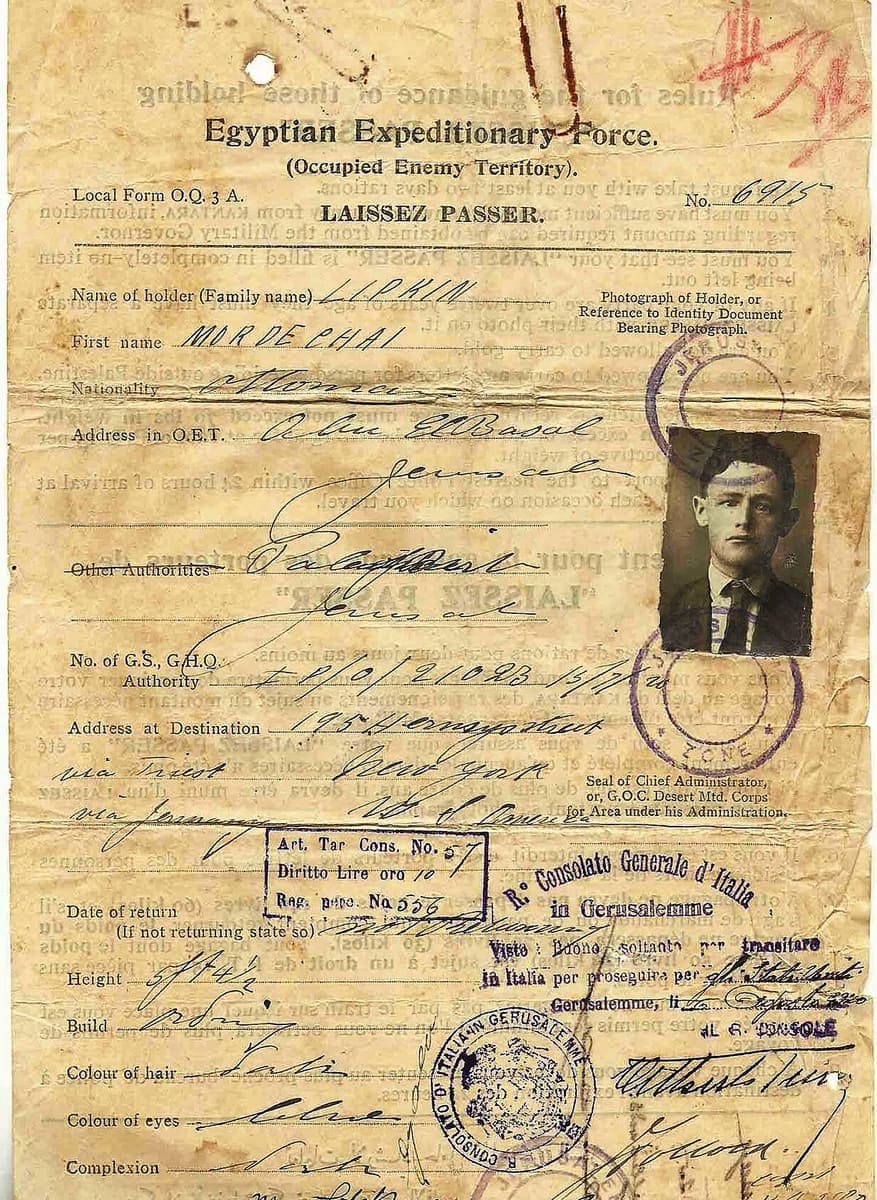
Source · Public domain · British Mandate authorities; the holder died long ago
Evidano Transcription
Egyptian Expeditionary Force.
(Occupied Enemy Territory).
Local Form O.Q. 3 A. No. 6915
LAISSEZ PASSER.
Name of holder (Family name) LIPKIN Photograph of Holder, or
Reference to Identity Document
First name MORDECHAI Bearing Photograph.
O.E.T.A. JERUSALEM ZONE
Nationality Ottoman
Address in O.E.T. Abu El Basal
Jerusalem
Other Authorities Palestine
Jerusalem
[illegible]
No. of G.S., G.H.Q.
Authority E/P/O/21023 13/7/20
Address at Destination 195 Henry street
via Triest New York O.E.T.A. JERUSALEM ZONE
via Germany U S America Seal of Chief Administrator,
or, G.O.C. Desert Mtd. Corps
for Area under his Administration.
Art. Tar Cons. No. 57
Diritto Lire oro 10 R. Consolato Generale d'Italia
Date of return Not returning Reg. pos. No 556 in Gerusalemme
(If not returning state so) Visto : Buono soltanto per transitare
Height 5 ft 4 1/2 in Italia per proseguire per gli Stati Uniti
Build Ordinary Gerusalemme, li 12 Agosto 1920
Colour of hair Fair R. CONSOLATO D'ITALIA IN GERUSALEMME IL R. CONSOLE
Colour of eyes Blue [illegible]
Complexion Fair [illegible]
no dist marks
Generated by Evidano’s advanced model; not yet checked against a published edition.
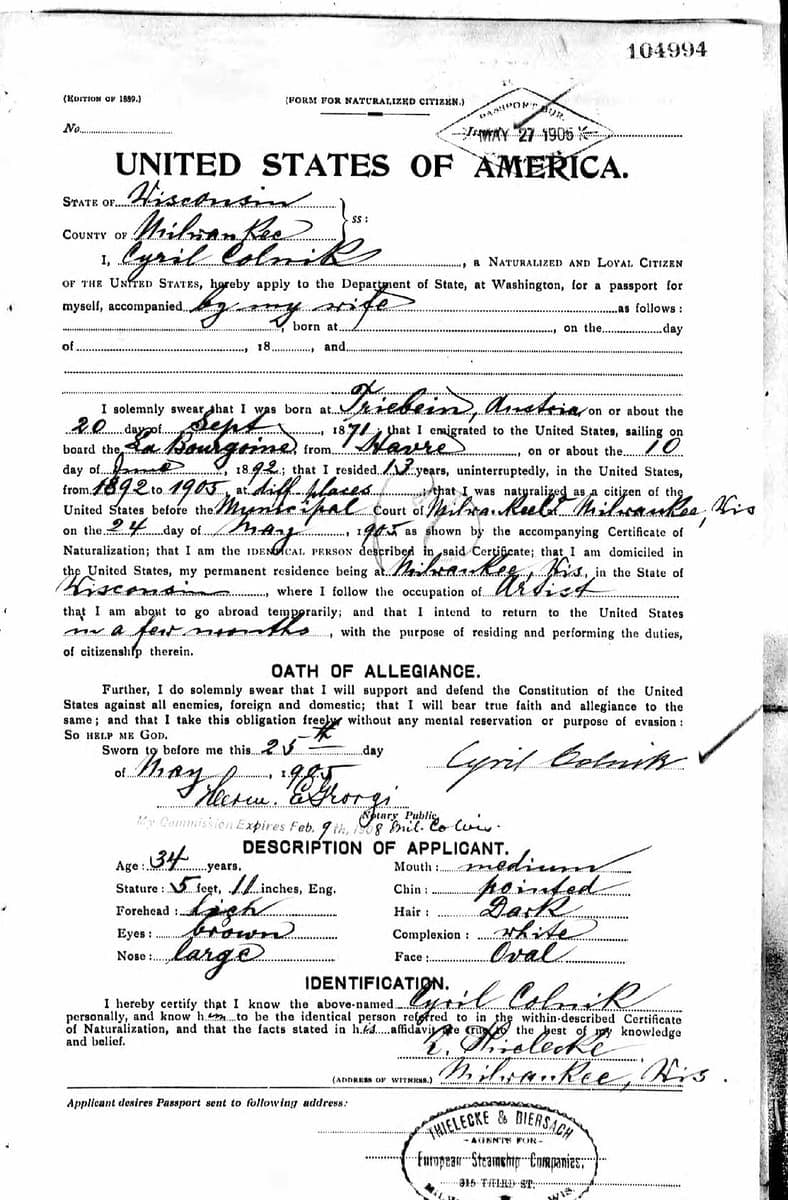
United States Passport Office records, 25 May 1905 · Source · Public domain
Evidano Transcription
104994
(EDITION OF 1889.) [FORM FOR NATURALIZED CITIZEN.]
No. .......... [stamp: PASSPORT BUR. MAY 27 1905]
UNITED STATES OF AMERICA.
STATE OF Wisconsin } ss:
COUNTY OF Milwaukee }
I, Cyril Colnik, a NATURALIZED AND LOYAL CITIZEN OF THE UNITED STATES, hereby apply to the Department of State, at Washington, for a passport for myself, accompanied by my wife as follows: .........., born at .........., on the ...... day of .........., 18....., and ..........
I solemnly swear that I was born at Trieben, Austria on or about the 20 day of Sept, 1871; that I emigrated to the United States, sailing on board the La Bourgogne from Havre, on or about the 10 day of June, 1892; that I resided 13 years, uninterruptedly, in the United States, from 1892 to 1905, at diff. places; that I was naturalized as a citizen of the United States before the Municipal Court of Milwaukee, Milwaukee, Wis. on the 24 day of May, 1905, as shown by the accompanying Certificate of Naturalization; that I am the IDENTICAL PERSON described in said Certificate; that I am domiciled in the United States, my permanent residence being at Milwaukee, Wis., in the State of Wisconsin, where I follow the occupation of Artist; that I am about to go abroad temporarily; and that I intend to return to the United States in a few months, with the purpose of residing and performing the duties of citizenship therein.
OATH OF ALLEGIANCE.
Further, I do solemnly swear that I will support and defend the Constitution of the United States against all enemies, foreign and domestic; that I will bear true faith and allegiance to the same; and that I take this obligation freely without any mental reservation or purpose of evasion: So help me God.
Sworn to before me this 25th day of May, 1905. Cyril Colnik
Herm. Georgi, Notary Public.
My Commission Expires Feb. 9th, 1908 Mil. Co. Wis.
DESCRIPTION OF APPLICANT.
| Age: | 34 years. | Mouth: | medium |
| Stature: | 5 feet, 11 inches, Eng. | Chin: | pointed |
| Forehead: | high | Hair: | Dark |
| Eyes: | brown | Complexion: | White |
| Nose: | large | Face: | Oval |
IDENTIFICATION.
I hereby certify that I know the above-named Cyril Colnik personally, and know him to be the identical person referred to in the within-described Certificate of Naturalization, and that the facts stated in his affidavit are true to the best of my knowledge and belief.
E. Thielecke
(ADDRESS OF WITNESS.) Milwaukee, Wis.
Applicant desires Passport sent to following address:
[stamp: THIELECKE & DIERSACH · AGENTS FOR · European Steamship Companies · 315 THIRD ST.]
Generated by Evidano’s advanced model; not yet checked against a published edition.
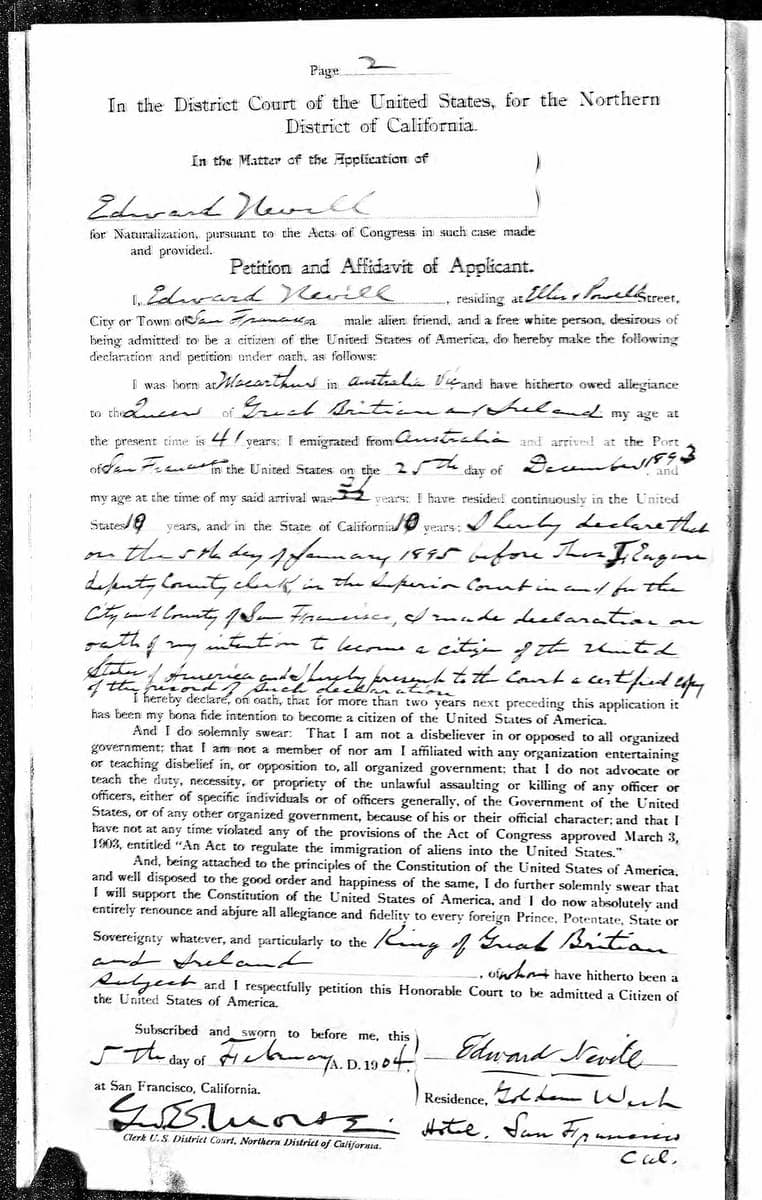
US Federal naturalization records, California, 5 February 1904 · Source · Public domain
Evidano Transcription
Page 2
In the District Court of the United States, for the Northern
District of California.
In the Matter of the Application of )
)
Edward Nevill )
for Naturalization, pursuant to the Acts of Congress in such case made
and provided.
Petition and Affidavit of Applicant.
I, Edward Nevill , residing at Ellis & Powell Street,
City or Town of San Francisco a male alien friend, and a free white person, desirous of
being admitted to be a citizen of the United States of America, do hereby make the following
declaration and petition under oath, as follows:
I was born at Macarthur in Australia Vic and have hitherto owed allegiance
to the Queen of Great Britian and Ireland my age at
the present time is 41 years; I emigrated from Australia and arrived at the Port
of San Francisco in the United States on the 25th day of December 1893 and
my age at the time of my said arrival was 32 years; I have resided continuously in the United
States 10 years, and in the State of California 10 years; I hereby declare that
on the 5th day of January 1895 before Thos F. Eugene
deputy County Clerk in the Superior Court in and for the
City and County of San Francisco, I made declaration on
oath of my intention to become a citizen of the United
States of America and I hereby present to the Court a certified copy
of the record of such declaration
I hereby declare, on oath, that for more than two years next preceding this application it
has been my bona fide intention to become a citizen of the United States of America.
And I do solemnly swear: That I am not a disbeliever in or opposed to all organized
government; that I am not a member of nor am I affiliated with any organization entertaining
or teaching disbelief in, or opposition to, all organized government; that I do not advocate or
teach the duty, necessity, or propriety of the unlawful assaulting or killing of any officer or
officers, either of specific individuals or of officers generally, of the Government of the United
States, or of any other organized government, because of his or their official character; and that I
have not at any time violated any of the provisions of the Act of Congress approved March 3,
1903, entitled "An Act to regulate the immigration of aliens into the United States."
And, being attached to the principles of the Constitution of the United States of America,
and well disposed to the good order and happiness of the same, I do further solemnly swear that
I will support the Constitution of the United States of America, and I do now absolutely and
entirely renounce and abjure all allegiance and fidelity to every foreign Prince, Potentate, State or
Sovereignty whatever, and particularly to the King of Great Britian
and Ireland , of whom I have hitherto been a
Subject and I respectfully petition this Honorable Court to be admitted a Citizen of
the United States of America.
Subscribed and sworn to before me, this )
5th day of February A. D. 1904 ) Edward Nevile
at San Francisco, California. )
) Residence, Golden West
[illegible] Morse ) Hotel, San Francisco
Clerk U. S. District Court, Northern District of California. Cal.
Generated by Evidano’s advanced model; not yet checked against a published edition.
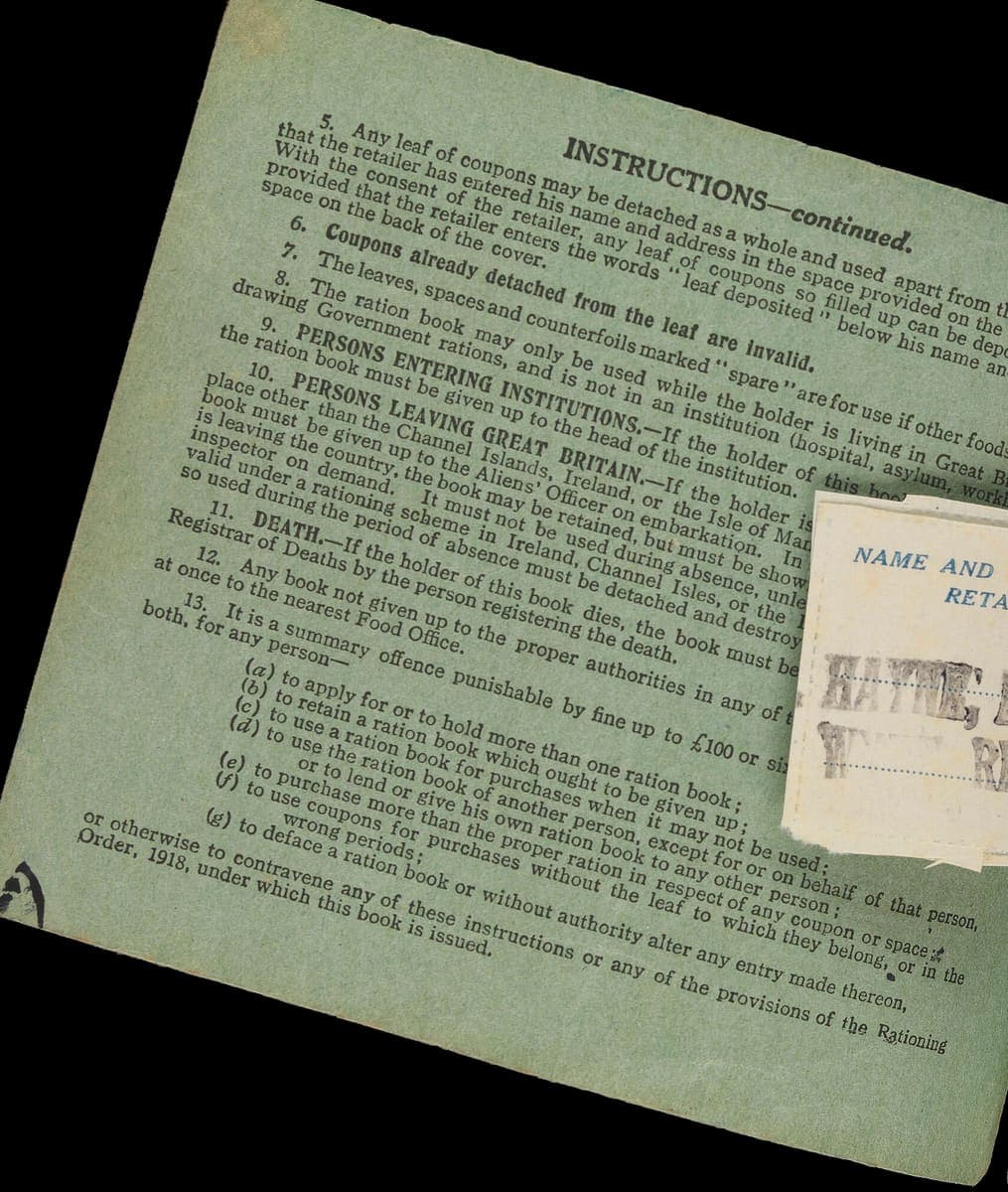
Wellcome Collection, c. 1918 · Source · CC BY 4.0 · Wellcome Collection, London
Evidano Transcription
INSTRUCTIONS—continued.
5. Any leaf of coupons may be detached as a whole and used apart from th[supplied: e]
that the retailer has entered his name and address in the space provided on the
With the consent of the retailer, any leaf of coupons so filled up can be depo[supplied: sited]
provided that the retailer enters the words "leaf deposited" below his name an[supplied: d]
space on the back of the cover.
6. Coupons already detached from the leaf are invalid.
7. The leaves, spaces and counterfoils marked "spare" are for use if other foods
8. The ration book may only be used while the holder is living in Great Br[supplied: itain]
drawing Government rations, and is not in an institution (hospital, asylum, workh[supplied: ouse]
9. PERSONS ENTERING INSTITUTIONS.—If the holder of this boo[supplied: k]
the ration book must be given up to the head of the institution.
10. PERSONS LEAVING GREAT BRITAIN.—If the holder is
place other than the Channel Islands, Ireland, or the Isle of Man
book must be given up to the Aliens' Officer on embarkation. In
is leaving the country, the book may be retained, but must be show[supplied: n]
inspector on demand. It must not be used during absence, unle[supplied: ss]
valid under a rationing scheme in Ireland, Channel Isles, or the I[supplied: sle of Man]
so used during the period of absence must be detached and destroy[supplied: ed]
11. DEATH.—If the holder of this book dies, the book must be
Registrar of Deaths by the person registering the death.
12. Any book not given up to the proper authorities in any of t[supplied: he]
at once to the nearest Food Office.
13. It is a summary offence punishable by fine up to £100 or si[supplied: x]
both, for any person—
(a) to apply for or to hold more than one ration book;
(b) to retain a ration book which ought to be given up;
(c) to use a ration book for purchases when it may not be used;
(d) to use the ration book of another person, except for or on behalf of that person,
or to lend or give his own ration book to any other person;
(e) to purchase more than the proper ration in respect of any coupon or space;
(f) to use coupons for purchases without the leaf to which they belong, or in the
wrong periods;
(g) to deface a ration book or without authority alter any entry made thereon,
or otherwise to contravene any of these instructions or any of the provisions of the Rationing
Order, 1918, under which this book is issued.
[attached slip:]
NAME AND
RETA[supplied: ILER]
HAYNE[supplied: S]
[illegible]
Generated by Evidano’s advanced model; not yet checked against a published edition.
How an official document is put together
The family is wide: birth, marriage and death certificates, naturalisation and citizenship papers, passports and travel permits, licences, registration cards, ration and identity books, service records, court and notarial instruments. Nearly all of them are a printed frame with a small amount of variable data dropped into it. The frame carries the issuing authority, the form number, the legal wording and the field labels; the data is typed, written or later machine-printed on the rules between them. A serial number is usually printed in a different colour or by a different press, so it is often the sharpest thing on the page and the easiest to misread by one digit.
On top of the frame sits everything added afterwards. Rubber stamps record that the document was seen, entered, filed or paid for, each with a date in its own format and often across text that was already there. Embossed or wet seals raise the paper and disappear in flat light. Endorsements, visas and countersignatures crowd the margins, sometimes in another language and another script. Older papers may have printed clauses struck out where they did not apply, and amendments written in and initialled — those deletions are part of the meaning, not damage.
Modern identity documents add a machine layer. A passport data page carries two lines of the machine-readable zone in OCR-B, in which the country and nationality are three-letter codes, dates are six digits, the name field uses double chevrons between surname and given names, and filler chevrons run to the end of the line; the last character of each group is a check digit. Around it are guilloche patterns, microprinting, holograms and a ghost portrait, all designed to defeat copying — and all of which the reading has to ignore rather than turn into characters.
Why ordinary OCR struggles here
Security printing is designed to interfere
Guilloche backgrounds, rainbow tints, watermarks, microtext and holographic overlays exist precisely to make reproduction hard. They sit under the data, so a reading has to separate the value from the pattern, and holograms on a card change what is legible with the smallest change of angle.
Fields, not sentences
Surname, given names, place of birth, date of issue, authority: these mean nothing without their labels, and the labels may be above, beside or a long way from the value across a dotted rule. A transcription that returns a list of words in reading order loses which value belongs to which field.
Stamps, seals and endorsements over text
A violet stamp landing across a handwritten line obscures part of both. The date inside the stamp matters, the text underneath matters, and the two have to be reported separately rather than merged into one confused string of characters.
Dates and codes that look like ordinary numbers
A date may be written 05/06/23, 5 JUN 23 or 230605, and only the document tells you which order the parts run in. Nationality codes, form numbers, batch marks and check digits are all bare alphanumerics, and a single wrong character in a document number is worse than an obvious gap.
Who works with this material
Archives and record offices
Registers, licences and permits are digitised by the metre, and item-level indexes are what make them findable. Pulling names, dates and reference numbers out as fields turns a shelf of images into a catalogue that a reader can search.
Family historians
Certificates and immigration papers are the load-bearing evidence in a pedigree. Exact spellings, ages, occupations and place names matter, and a note of what is illegible is more useful than a confident reading that quietly settles the wrong ancestor on a family.
Legal and immigration case workers
A case file arrives as photographs of documents in several languages and formats. Getting a consistent set of fields out of them, with stamps and endorsements recorded separately, is what makes a chronology possible.
Back-office teams handling verification
Onboarding and compliance work involves reading data pages and certificates at volume. Here the requirement is as much about handling as about accuracy: only the fields that are needed, held only as long as necessary, with the rest never leaving the image.
Getting the best transcription
Decide what you are allowed to keep
Before anything is uploaded, settle which fields you actually need and which should be masked or dropped. It is usually possible to work from a document number and an expiry date without ever extracting a full name, an address or a photograph.
Photograph flat, in even light, both sides
Lay the document on a plain surface, avoid direct light on laminate or a hologram, and capture the back as well — endorsements, continuation stamps and the machine-readable zone often live there. For a booklet, photograph the opening flat rather than at an angle.
Name the fields you want returned
Ask for a field list — surname, given names, document number, date of issue, expiry, issuing authority — rather than a block of text. Say which date format you want, and ask for the value as printed alongside any normalised form so the reading can be checked.
Treat numbers as needing a second look
Document numbers, reference codes and check digits are exactly where a single-character error does the most damage. Have them read back a second time, compare the two readings, and flag any disagreement instead of accepting the first result.
Frequently asked questions
- Can it read the machine-readable zone on a passport?
- The two lines of OCR-B can be transcribed, including the chevron fillers, the three-letter country and nationality codes and the six-digit dates. Because each group ends in a check digit, the values can be checked arithmetically, which is the quickest way to catch a misread character.
- How is personal data handled?
- Extract only the fields you need and mask the rest — cover a photograph, a signature or an address before uploading, or ask for those fields to be omitted from the output. Every sample shown on this page is a historical document whose subject died long ago, or a blank or specimen form.
- Are stamps and seals transcribed?
- Yes, as separate elements. A rubber stamp is reported with its text and any date, an embossed seal is described where it cannot be read, and both are kept apart from the text they were pressed across so that neither corrupts the other.
- What about handwritten amendments to a printed form?
- They are marked as handwritten and kept distinct from the printed frame. A struck-out clause is reported as deleted rather than dropped, which matters, because on many older forms the deletions are how the document says what it means.
- Can it work from a photograph taken with a phone?
- Usually, provided the whole document is in frame, the lighting is even and the plane of the page is roughly parallel to the camera. The common failures are a flash reflection across a laminated card and a corner cropped off, both of which are cheaper to fix by retaking the picture.
- What if the document is in two languages or two scripts?
- Bilingual certificates and permits are common, and each version can be returned as its own block with its language named. Non-Latin script on the same page — an Arabic or Hebrew endorsement beside English — is transcribed in its own right rather than transliterated by default.
Related scripts and pages
Read official papers as data
Upload a certificate, permit or archival record, choose Official and Identity Documents, and name the fields you want — and the ones you would rather never leave the image.