
French · c. 1650–1800
Read minutes, registers and royal letters of the ancien régime
A notary’s clerk in 1700 wrote a hand that slopes hard to the right, fills every line-end with a ruled dash, and cuts ledit, ladite and lesdits down to two letters and a flourish. Around the text sit the things that make the document work: a docket in the margin, a registration note, a tax stamp, a paraph. Evidano transcribes the body and those marginal marks together, so the act stays legible as an act.
Sample pages
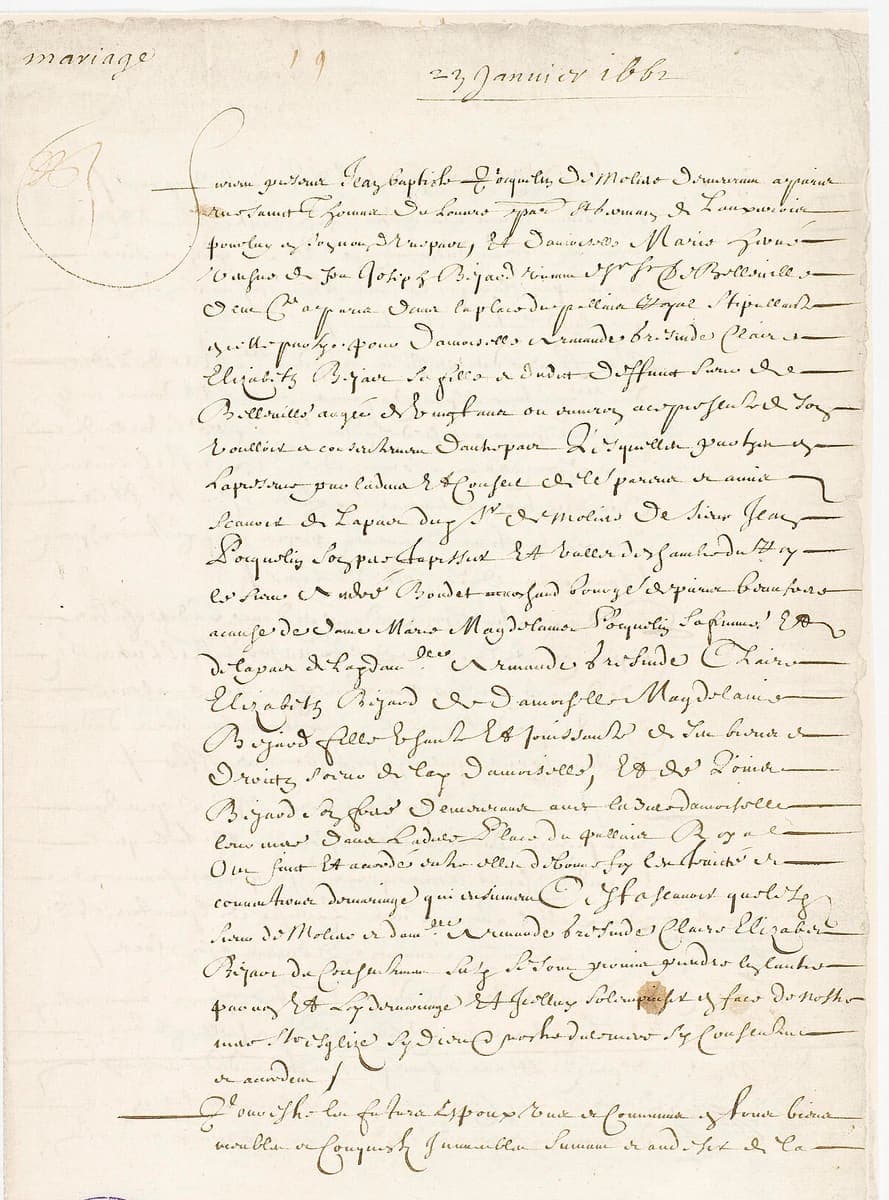
Archives nationales (France), Minutier central, ET/XLII/152, 23 January 1662 · Source · Public domain
Evidano Transcription
The first page of the minute, from the opening of the act to the clause on community of goods on which the page breaks off, in Soulié’s edition of the Acloque minutes. The editor expands the notary’s superscript abbreviations silently, modernises the spelling, and supplies the punctuation and the paragraph breaks; the marginal docket, the paraph and the archival stamp are not part of the edited text.
Furent présents Jean-Baptiste Poquelin de Molière, demeurant à Paris, rue Saint-Thomas-du-Louvre, paroisse Saint-Germain-de-l’Auxerrois, pour lui en son nom, d’une part ; et damoiselle Marie Hervé, veuve de feu Joseph Béjard, vivant écuyer, sieur de Belleville, demeurant à Paris, dans la place du Palais-Royal, stipulant en cette partie pour damoiselle Armande-Grésinde-Claire-Élisabeth Béjard, sa fille, et dudit défunt sieur de Belleville, âgée de vingt ans ou environ, à ce présente de son vouloir et consentement, d’autre part ; lesquelles parties en la présence, par l’avis et conseil de leurs parents et amis, savoir, de la part dudit sieur de Molière : de sieur Jean Poquelin, son père, tapissier et valet de chambre du Roi, et sieur André Boudet, marchand bourgeois de Paris, beau-frère à cause de damoiselle Marie-Madeleine Poquelin, sa femme ; et de la part de ladite damoiselle Armande-Grésinde-Claire-Élisabeth Béjard : de damoiselle Madeleine Béjard, fille usante et jouissante de ses biens et droits, sœur de ladite damoiselle, et de Louis Béjard, son frère, demeurant avec ladite damoiselle, leur mère, dans ladite place du Palais-Royal, ont fait et accordé entre elles de bonne foi les traité et conventions de mariage qui ensuivent. C’est à savoir que lesdits sieur de Molière et damoiselle Armande-Grésinde-Claire-Élisabeth Béjard, du consentement susdit, se sont promis prendre l’un l’autre par nom et loi de mariage, et icelui solenniser en face de notre mère sainte Église, si Dieu et notre dite mère s’y consentent et accordent.
Pour être les futurs époux uns et communs en tous biens meubles et conquêts immeubles, suivant et au désir de la coutume de cette ville, prévôté et vicomté de Paris.
Source: Eudore Soulié, Recherches sur Molière et sur sa famille (Paris, 1863), document XXX, via Internet Archive (Public domain).
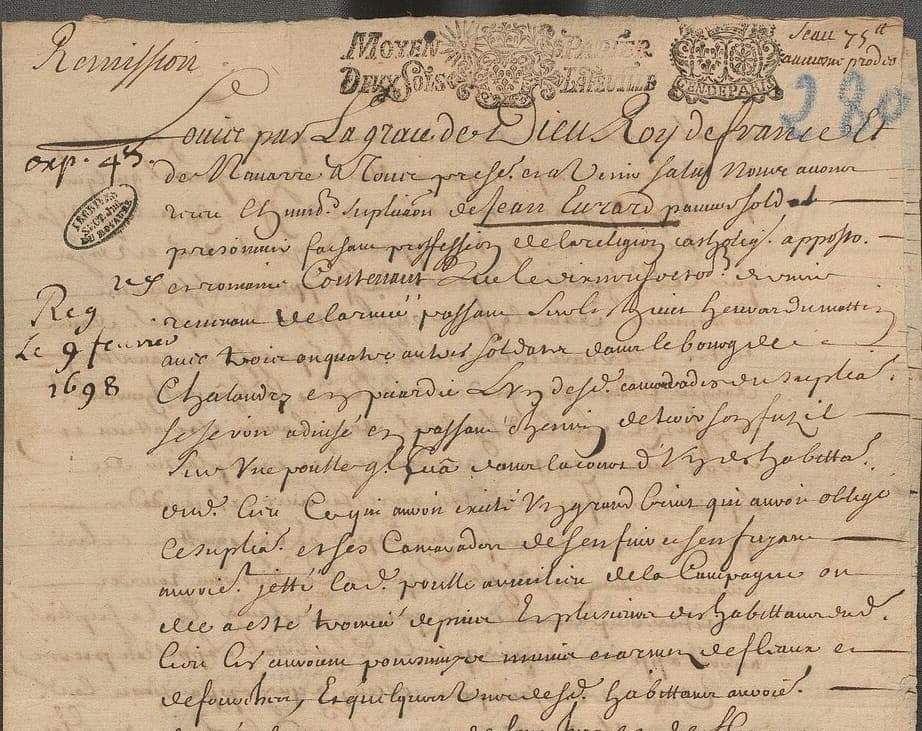
Archives nationales (France), V/1/545, no. 180, January 1698 · Source · CC0 1.0 · Archives nationales (France), released under CC0
Evidano Transcription
Left margin
Remission
exp. 45.
[stamp]
Reg
Le 9 fevrier
1698
MOYEN
DEUX SOLS
PAPIER
LA FEUILLE
GEN. DE PARIS
Sceau 75 lt
aumosne pro deo
280
Louis par La grace de Dieu Roy de france Et
de Navarre A Tous presens et a Venir Salut Nous avons
receu L'humb[le] Supplica[ti]on de Jean Euvard[?] pauvre soldat
prisonnier faisant proffession de la religion catholiq[ue] aposto.
et romaine Contenant Que le vingt neuf octob[re] dernier
revenant de l'armée passant Seul avec heuvar du mottez[?]
avec trois ou quatre autres Soldats dans le bourg de
Chalandry en picardie Lun desd[its] camarades du supliant
Se seroit advisé en passant d'envie de tirer son fuzil
Sur Vne poulle q[ui] Etoit dans la cour d'Vn des habittans
dud[it] lieu Ce qui auroit excité Vn sy grand bruit qui auroit obligé
le supliant et ses Camarades de s'en fuir et s'en fuyant
auroient jetté lad[ite] poulle au millieu de la Campagne ou
elle a esté trouvée depuis Et plusieurs des habittans dud[it]
lieu les auroient poursuivis munis d'armes de fleaux et
de fourches, Et quelques Vns desd[its] habittans auroient
[cut off]
Generated by Evidano’s advanced model; not yet checked against a published edition.
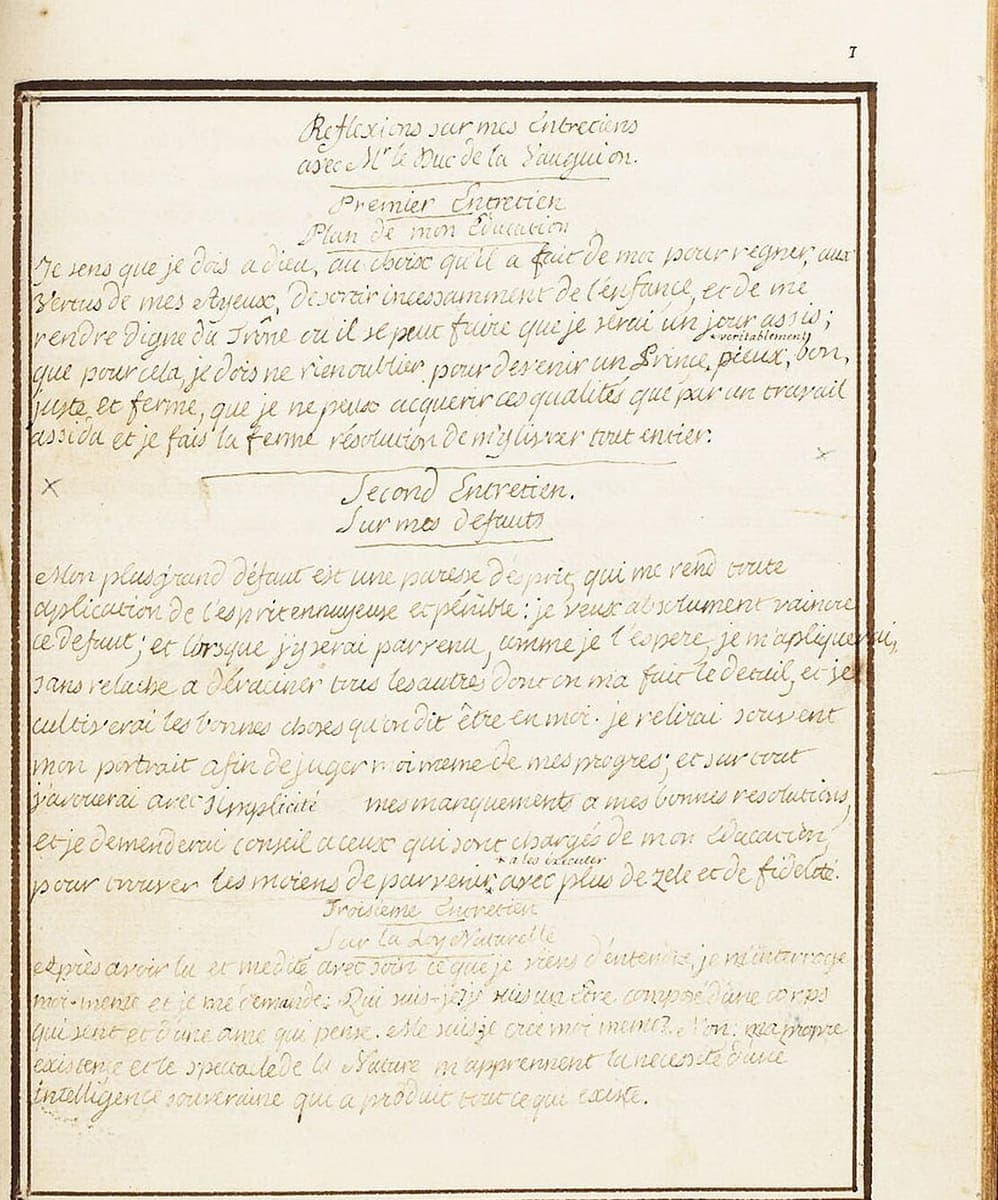
Archives nationales (France), AE/I/4/1bis, c. 1767–1769 · Source · Public domain · Archives nationales (France), via the Wikimédia France cooperation project
Evidano Transcription
The whole page, headings included, in the transcription made by the Archives nationales and validated on French Wikisource. The writer’s own spelling is kept — aplication, moiens, éducacion, loy — accents are supplied, and the round brackets in d’un(e) corps are the editor’s note of an uncorrected slip; the words added above the line are absorbed into the text.
Réflexions sur mes entretiens avec Mr le duc de La Vauguyon
Premier entretien
Plan de mon éducation
Je sens que je dois à Dieu, au choix qu’il a fait de moi pour régner, aux vertus de mes ayeux, de sortir incessamment de l’enfance, et de me rendre digne du trône où il se peut faire que je serai un jour assis ; que pour cela, je dois ne rien oublier pour devenir un prince véritablement pieux, bon, juste et ferme, que je ne peux acquérir ces qualités que par un travail assidu et je fais la ferme résolution de m’y livrer tout entier.
Second entretien
Sur mes défauts
Mon plus grand défaut est une paresse d’esprit, qui me rend toute aplication de l’esprit ennuyeuse et pénible : je veux absolument vaincre ce défaut ; et lorsque j’y serai parvenu, comme je l’espère, je m’apliquerai sans relâche à déraciner tous les autres dont on m’a fait le détail, et je cultiverai les bonnes choses qu’on dit être en moi. Je relirai souvent mon portrait afin de juger moi-même de mes progrès ; et surtout j’avouerai avec simplicité mes manquements à mes bonnes résolutions, et je demenderai conseil à ceux qui sont chargés de mon éducacion, pour trouver les moiens de parvenir à les exécuter avec plus de zèle et de fidélité.
Troisième entretien
Sur la loy naturelle
Après avoir lu et médité avec soin ce que je viens d’entendre, je m’interroge moi-même et je me demande : qui suis-je ? Je suis un être composé d’un(e) corps qui sent et d’une âme qui pense. Me suis-je créé moi-même ? Non : ma propre existence et le spectacle de la nature m’apprennent la nécessité d’une intelligence souveraine qui a produit tout ce qui existe.
Source: Archives nationales, transcription of AE/I/4/1bis, validated text on French Wikisource (CC BY-SA 4.0).
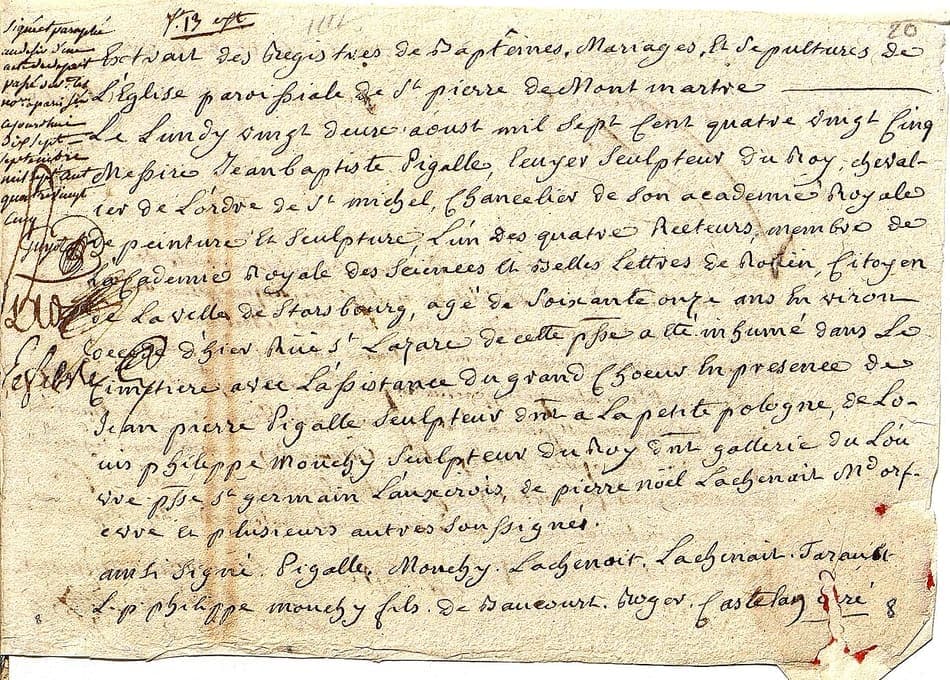
Archives nationales (France), Minutier central, 22 August 1785 · Source · CC BY-SA 4.0 · Archives nationales (France), via Wikimedia Commons
Evidano Transcription
V. 13 sept 20
Extrait des Registres de Baptemes, Mariages, et Sepultures de
L'eglise paroissiale de s[ain]t pierre de Montmartre
Le Lundy vingt deux aoust mil sept cent quatre vingt cinq
Messire Jean baptiste Pigalle, ecuyer Sculpteur du Roy, cheval-
ier de L'ordre de s[ain]t michel, Chancelier de son academie Royale
de peinture et Sculpture, L'un des quatre Recteurs, membre de
L'academie Royale des Sciences et Belles Lettres de Roüen, Citoyen
de la ville de Starsbourg, agé de Soixante onze ans Environ
decedé d'hier Rüe s[ain]t Lazare de cette p[aroi]sse a eté inhumé dans Le
Cimetiere avec L'asistance du grand Choeur En presence de
Jean pierre Pigalle Sculpteur d[emeura]nt a La petite pologne, de Lo-
uis philippe mouchy Sculpteur du Roy d[emeura]nt gallerie du Lou
vre p[aroi]sse s[ain]t germain L'auxerrois, de pierre noël Lachenait M[ait]re orf-
evre et plusieurs autres Soussignés.
ainsi Signé. Pigalle, Mouchy. Lachenait. Lachenait. Tarault
L. p philippe mouchy fils. de daucourt. buger. Castelan curé
Signé et paraphé
au desir d'un
acte de depost
passé dev[ant] les
no[tai]res a paris sou[ssignés][?]
aujourdhui
dix sept
septembre
mil sept cent
quatre vingt
cinq
Guyot
Lefebvre
Generated by Evidano’s advanced model; not yet checked against a published edition.
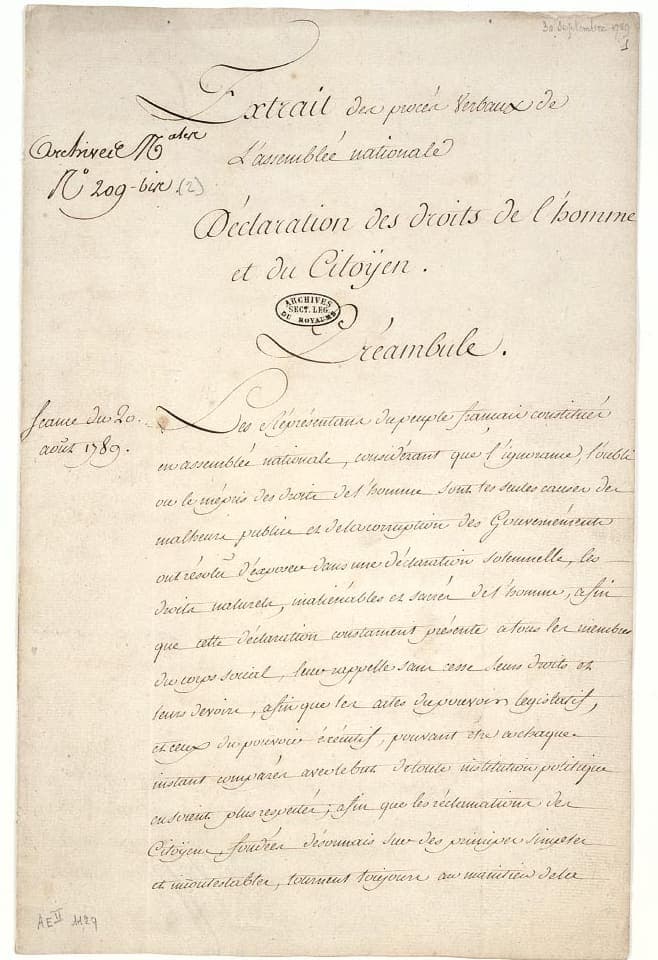
Archives nationales (France), AE/II/1129, 1789 · Source · Public domain · Archives nationales (France), via the Wikimédia France cooperation project
Evidano Transcription
The whole sheet, in the transcription made by the Archives nationales and validated on French Wikisource: the date at the head, the archival registration in the margin, the titles and the preamble as far as the page break, which falls in mid-sentence. The clerk’s spelling Citoÿen with the diaeresis is kept, accents are supplied and capitals follow the manuscript.
30 septembre 1789
Archives Nales
No 209 - bis (2)
Séance du 20 août 1789
Extrait des procès verbaux de l’Assemblée nationale
Déclaration des droits de l’homme et du Citoÿen.
Préambule.
Les représentants du peuple français constitué en assemblée nationale, considérant que l’ignorance, l’oubli ou le mépris des droits de l’homme sont les seules causes des malheurs publics et de la corruption des Gouvernements ont résolu d’exposer dans une Déclaration solennelle, les droits naturels, inaliénables et sacrés de l’homme, afin que cette Déclaration, constamment présente à tous les membres du corps social, leur rappelle sans cesse leurs droits et leurs devoirs, afin que les actes du pouvoir législatif, et ceux du pouvoir exécutif, pouvant être à chaque instant comparés avec le but de toute institution politique en soient plus respectés ; afin que les réclamations des citoyens, fondées désormais sur des principes simples et incontestables, tournent toujours au maintien de la
Source: Archives nationales, transcription of AE/II/1129, validated text on French Wikisource (CC BY-SA 4.0).
The clerk’s hand and the shape of the act
Two conventions run side by side after 1650. Writing masters teach the ronde, an upright, round hand with heavy shading, and the coulée, its sloping cousin, and both are used for anything that has to be read by strangers: title pages, engrossed copies, the fair text of a deliberation. The working hand of the offices is a fast sloping cursive in which the long ſ still reaches below the line, e is an open loop that can be taken for c, capital I and J are the same letter, and terminal r, s and x are pulled into the following word. By the 1780s the sloping hand has grown rounder and lighter and the long ſ is on its way out, but it has not gone.
Abbreviation is now formulaic rather than graphic. Superscript letters carry the endings of the words a clerk writes fifty times a day: led., lad., lesd., sr, dlle, Md, p.r for pour, q. for que, and the honorifics Mons.r and M.re. The notary marks paragraphs with a deep indent and rules the rest of the line with a long dash so that nothing can be added later. Sums are written twice, in words and in figures, in livres, sous and deniers; dates are spelled out in full, le lundy vingt deuxième aoust mil sept cent quatre-vingt-cinq, and the year of the reign or the regnal formula may follow.
The apparatus around the text is part of the record. A minute carries a docket in the head margin (mariage, testament, inventaire), the notary’s paraph, and later the stamp of the Minutier central. Royal letters are written on stamped paper whose printed cartouche gives the paper duty and the généralité, and they are annotated in the margin with the registration date and the fee. Parish acts are copied out as extraits with the officiating priest’s clause and the signatures of the witnesses in their own hands, and administrative registers carry running marginal summaries put there so that a clerk could find an entry without reading it.
Why ordinary OCR struggles here
Formulas compressed to a superscript
A clerk writes led., lad., lesd., sr and dlle hundreds of times a page and reduces them to a letter with a stroke over it. Read as ordinary words they produce gibberish; expanded without a record they hide which party an act is talking about.
Line-fillers that look like text
Notarial minutes end every line with a long ruled dash so that nothing can be added later, and the same stroke is used to cancel blank space. Layout analysis reads these as hyphens or as characters and splices them into the words on either side.
Marginal apparatus that carries the legal force
The docket, the registration date, the fee, the tax stamp on the paper and the paraph are what make an act enforceable. Cropped away or merged into the body they leave a text that reads well and proves nothing.
Numbers written twice and in two systems
Sums appear in words and again in figures, ages and dates are spelled out, and money is counted in livres, sous and deniers. A misread figure in a dowry or a rent is not a typo but a different document.
Who works with this material
Genealogists working in notarial and parish series
Marriage contracts, wills and burial acts name parents, trades, parishes and witnesses. Getting those names out with their spellings intact is what lets a researcher follow a family across a département rather than guess at it.
Archivists producing item-level descriptions
A minute répertoire needs the date, the type of act and the parties for every piece in a liasse. A transcription of the first ten lines of each minute produces exactly that, and can be checked against the notary’s own répertoire.
Historians of law, crime and administration
Lettres de rémission, arrêts and registers of the chancery tell a story in a formulary. Once the formula is transcribed consistently, the narrative parts can be compared across hundreds of cases.
Editors of eighteenth-century papers and correspondence
Private notebooks, drafts and letters from this period mix a careful hand with hurried insertions. An edition needs both the fair text and the additions, marked as such and placed where the writer put them.
Getting the best transcription
Name the record type and the office
A minute from the Minutier central, a lettre de rémission from the Grande Chancellerie and a parish extract have different opening formulas. Telling the model which one it is lets it recognise the formula and spend its attention on the names and figures.
Supply the abbreviation list you want expanded
Give the standard set — led., lad., lesd., sr, dlle, p.r, q. — and say whether expansions should be bracketed. Consistency here is worth more than cleverness, because it is what makes a run of minutes searchable.
Ask for the margins as separate fields
Request the docket, the registration note, the fee, the stamp text and the paraph as labelled items rather than as part of the first line. That way the act can be indexed by its date of sealing as well as by its date of drafting.
Check the money and the names first
Review the sums, the ages and the proper names before anything else; the formulaic middle of an act is where the model is most reliable and the least interesting. A short checking pass over those fields catches almost every consequential error.
Further reading on this hand
The palaeography guides the in-app selector points to for this domain, if you want to check a transcription against the standard references.
- Cours de paléographie
This course from the Archives nationales de France teaches palaeography through French archival documents from the fourteenth through the eighteenth centuries. It provides document images and transcriptions organized by period and level of difficulty. The exercises expose users to changing administrative and private hands, abbreviations, numerical expressions, formulas, and archival document structure. Its seventeenth- and eighteenth-century selections are especially useful for notarial and governmental cursive.
Frequently asked questions
- Will it keep livres, sous and deniers apart from ordinary numbers?
- Money can be transcribed with its units as written, including the abbreviations l., s. and d. and the superscript forms, and repeated as a normalised figure if you want one. Because sums are usually given in words and again in figures, the two readings can be compared automatically.
- How are the signatures at the foot of an act handled?
- They are transcribed as a separate block, in the order they appear, and the formula that introduces them — ainsi signé, or the notary’s own subscription — is kept. Where a mark stands in place of a signature it is recorded as a mark rather than guessed at.
- Can the printed matter on stamped paper be read too?
- Yes, and it is worth having: the cartouche gives the duty and the généralité, which dates and localises the sheet. It is transcribed as a separate field so it does not run into the first line of the act.
- Does the long ſ still cause trouble in eighteenth-century hands?
- It does, because by this date it is written with barely any bar and sits next to an f whose crossbar is often skipped. The model is told to expect both, and a reviewer can settle the remaining cases from the vocabulary of the formula.
- What about a whole liasse of minutes in one hand?
- Working through a bundle written by one clerk is the easiest case: once the abbreviations and the line-fillers of that hand have been checked on the first few sheets, the rest follow with very little correction, and the checking effort moves to names and figures.
Related scripts and pages
Transcribe your ancien régime papers
Upload a minute, a register opening or a royal letter, choose French Notarial and Administrative Hands, and check one act before the liasse.