
French · c. 900–1200
Transcribe the first written French, letter by letter
The oldest French survives as a few pages of Romance tucked into Latin books: an oath copied by a Carolingian historian, a sequence on the back of a Latin hymn, a Passion squeezed into a glossary. The hands are Latin hands, so the abbreviation strokes, the Tironian ⁊ and the u that also stands for v all have to be read with a Romance ear. Evidano transcribes these folios line by line and lets you decide what is expanded and what is kept.
Sample pages
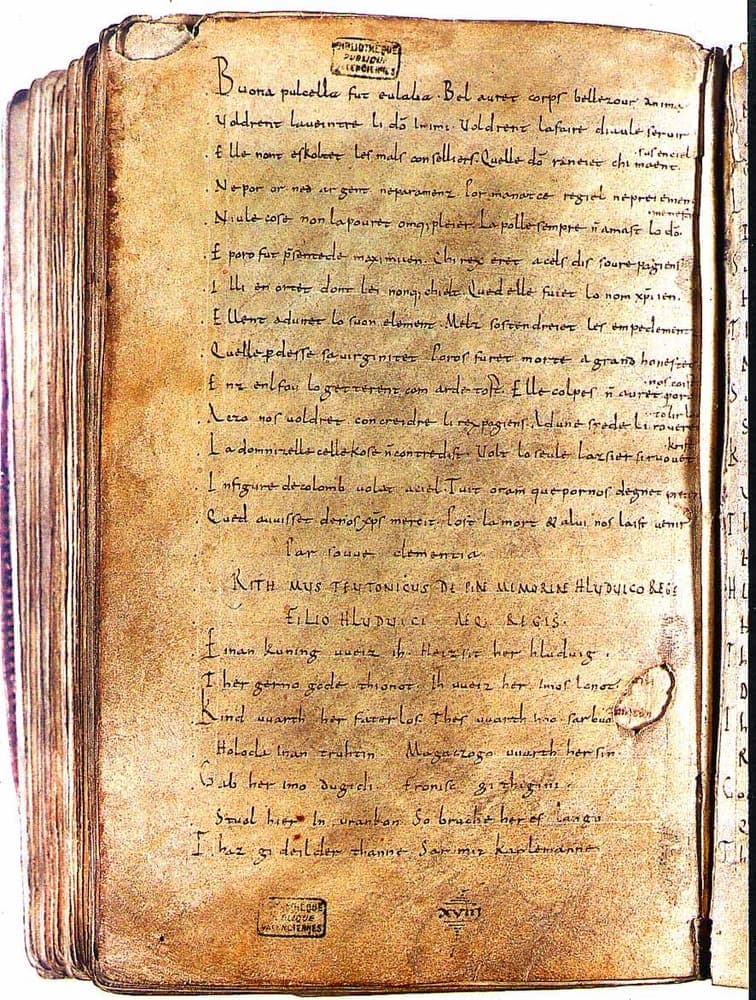
Bibliothèque municipale de Valenciennes, MS 150 (olim 143), f. 141v, c. 880 · Source · Public domain
Evidano Transcription
The twenty-nine verses of the French sequence, printed one verse per line although the scribe wrote two to a line. Letters in square brackets stand for abbreviation marks in the manuscript (dõ, omq̃, n̄, p̄, xp̃iien); [ ] marks a word the scribe wrote joined to the next; u/v and i/j follow the manuscript. The Ludwigslied that follows on the page is not included.
Buona pulcella fut Eulalia.
Bel avret corps bellezour anima.
Voldrent la veintre li d[õ] inimi.
Voldrent la faire diavle servir.
Elle nont eskoltet les mals conselliers.
Quelle d[õ] raneiet chi maent sus en ciel.
Ne por or ned argent ne paramenz.
Por manatce regiel ne preiement.
Niule cose non la pouret omq[ue] pleier.
La polle sempre n[on] amast lo d[õ] menestier.
E por[ ]o fut p[re]sentede maximiien.
Chi rex eret a cels dis soure pagiens.
Il[ ]li enortet dont lei nonq[ue] chielt.
Qued elle fuiet lo nom xp[ist]iien.
Ellent adunet lo suon element
Melz sostendreiet les empedementz.
Quelle p[er]desse sa virginitet.
Por[ ]os suret morte a grand honestet.
Enz enl fou lo getterent com arde tost.
Elle colpes n[on] avret por[ ]o nos coist.
A[ ]czo nos voldret concreidre li rex pagiens.
Ad une spede li roveret tolir lo chief.
La domnizelle celle kose n[on] contredist.
Volt lo seule lazsier si ruovet krist.
In figure de colomb volat a ciel.
Tuit oram que por[ ]nos degnet preier.
Qued avuisset de nos xr[istu]s mercit
Post la mort & a[ ]lui nos laist venir.
Par souue clementia.
Source: Séquence de sainte Eulalie, proofread transcription of Valenciennes MS 150, f. 141v, via French Wikisource (CC BY-SA 4.0).
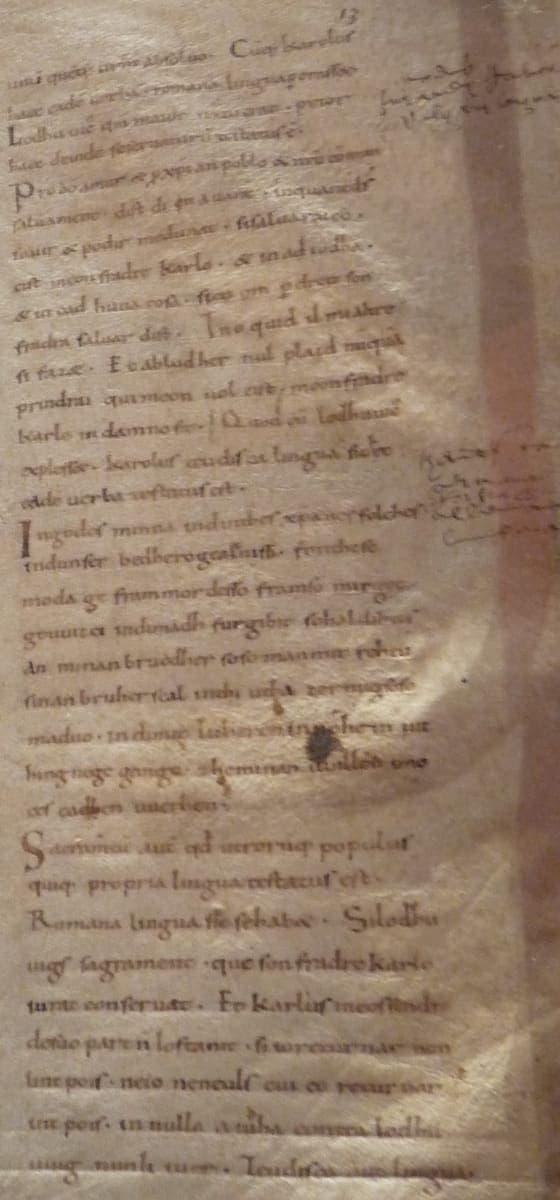
Bibliothèque nationale de France, MS lat. 9768, f. 13r, c. 1000 (text of 842) · Source · CC BY-SA 3.0 · Photograph by Ji-Elle, CC BY-SA 3.0, via Wikimedia Commons
Evidano Transcription
Louis the German’s oath in Romance, the eight manuscript lines beginning “Pro deo amur” in the middle of the page, in the reading with abbreviations resolved published on French Wikisource (dõ = deo, ᵽ = per/pro, xp̃ian = christian, nrõ = nostro); the same page also prints a raw transcription that keeps the marks. The Latin narrative, Charles’s German oath and the soldiers’ oaths lower on the folio are not included.
Pro Deo amur et pro christian poblo et nostro commun salvament, dist di in avant, in quant Deus savir et podir me dunat, si salvaraeio cist meon fradre Karlo, et in adiudha et in cadhuna cosa, si cum om per dreit son fradra salvar dist, in o quid il mi altresi fazet ; et ab Ludher nul plaid numquam prindrai, qui meon vol, cist meon fradre Karle in damno sit.
Source: Serments de Strasbourg, transcription of BnF lat. 9768, f. 13r, via French Wikisource (CC BY-SA 4.0).
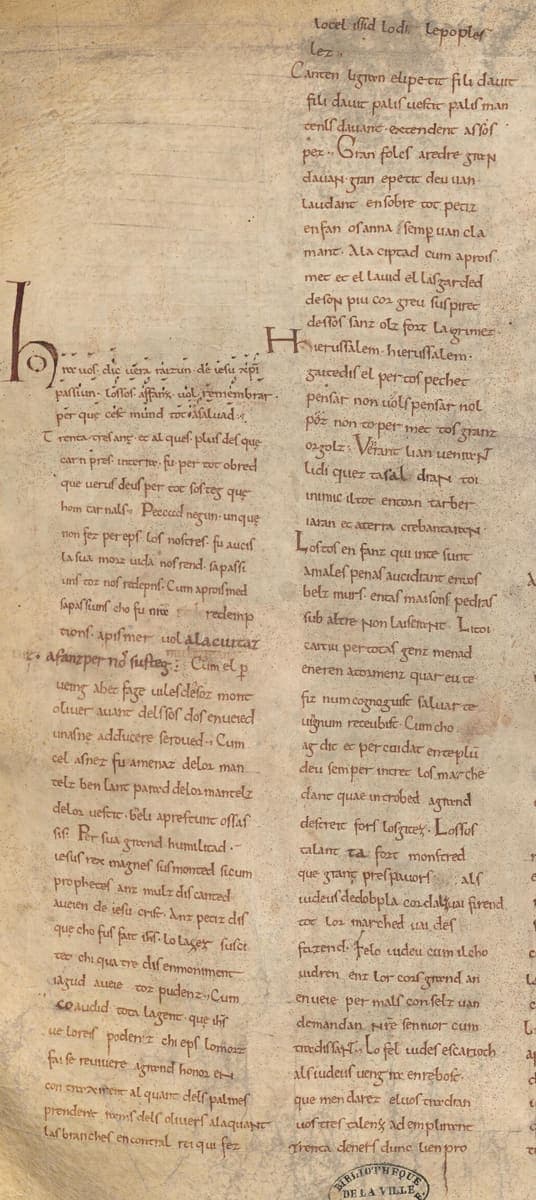
Bibliothèque du patrimoine, Clermont Auvergne Métropole, MS 240, f. 109v, c. 1000 · Source · Public domain · Digitised by the Bibliothèque du patrimoine de Clermont Auvergne Métropole (Overnia)
Evidano Transcription
Verses 1–40 (strophes 1–10), the whole of the first column, in Koschwitz’s diplomatic “texte original”, which prints one verse per line where the scribe ran them together, expands the abbreviations, marks elision with an apostrophe and keeps the manuscript’s spelling; OCR errors in the Internet Archive text (dic, que, cel, los sos) have been corrected against the page image.
Hora uos dic uera raizun
de Jesu Christi passiun:
los sos affanz uol remembrar
per que cest mund tot a saluad.
Trenta tres anz et alques plus,
des que carn pres, in terra fu:
per tot obred que uerus Deus,
per tot sosteg que hom carnals.
Peccad negun unque non fez,
per eps los nostres fu aucis:
la sua morz uida nos rend,
sa passiuns toz nos redemps.
Cum aproismed sa passiuns,
cho fu nostra redemptions,
aproismer vol a la ciutat:
afanz per nos susteg mult granz.
Cum el perveing a Betfage,
vil’ es desoz mont Oliver,
avant dels sos dos enveied,
un asn’ adducere se roved.
Cum cel asnez fu amenaz,
de lor mantelz ben l’ant parad:
de lor mantelz, de lor vestit
ben li aprestunt o s’assis.
Per sua grand humilitad
Jesus rex magnes sus monted,
sicum prophetes anz mulz dis
canted aveien de Jesu Crist.
Anz petiz dis que cho fus fait,
Jesus lo Lazer suscitet,
chi quatre dis en monument
jagud aveie toz pudenz.
Cum co audid tota la gent,
que Jesus ve, lo reis podenz,
chi eps lo morz fai se revivere,
a grand honor encontra ’xirent.
Alquant dels palmes prendent rams,
dels Olivers alaquant las branches;
encontra l rei qui fez lo cel,
issid lo di le poples lez.
Source: E. Koschwitz, Les plus anciens monuments de la langue française, 6th ed. (Leipzig, 1902), La Passion du Christ, texte original, via Internet Archive (Public domain).
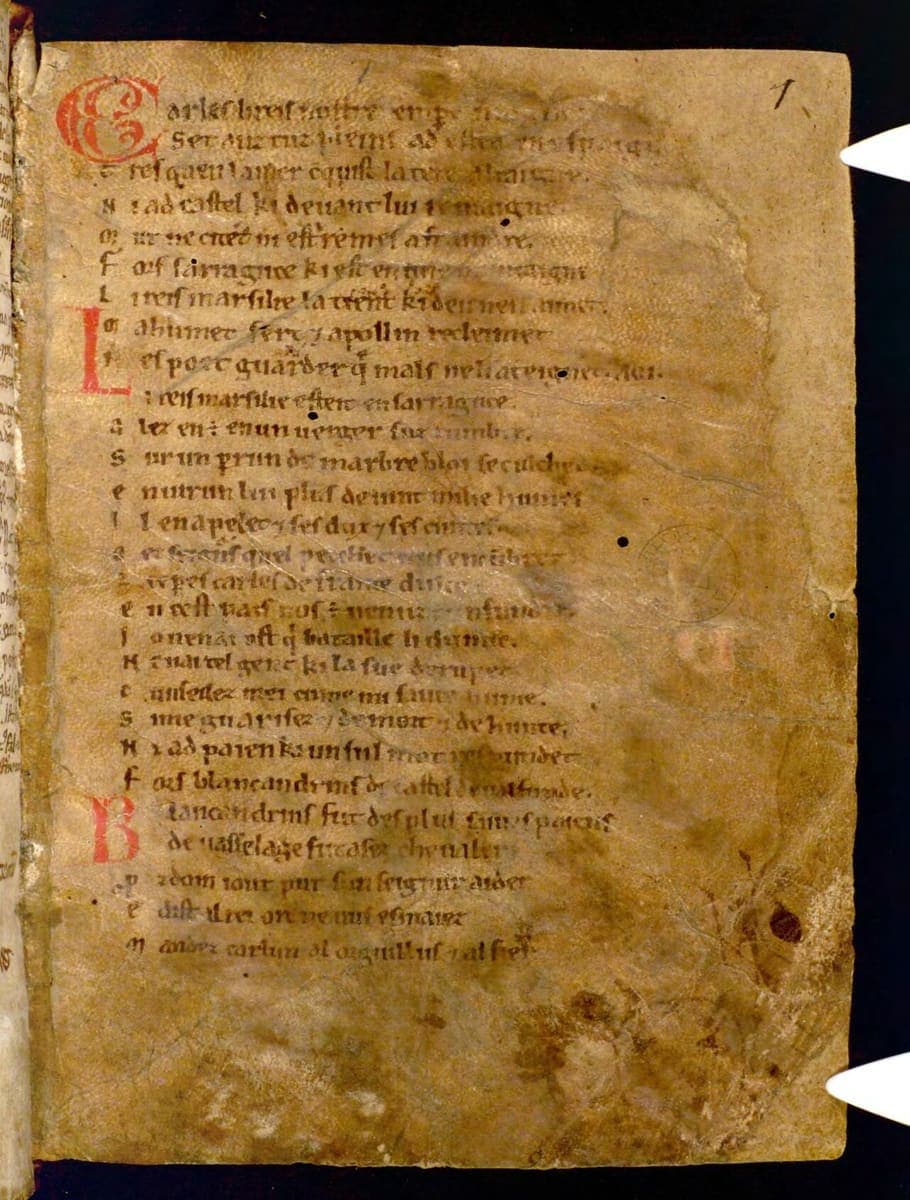
Bodleian Library, University of Oxford, MS Digby 23, pt. 2, f. 1r, c. 1125–1150 · Source · Public domain
Evidano Transcription
Lines 1–28 of the poem, the whole of f. 1r, in the diplomatic transcription made from this scan by French Wikisource contributors: long ſ, ⁊, ꝑ and the superscript-i qͥ are kept, ÷ reproduces the sign the scribe uses for est, and words in square brackets are supplied where the folio is illegible. Laisse numbers and line numbers are omitted.
Carleſ li reiſ noſtre emꝑe [magneſ]
Set anz tuz pleinſ ad [eſtet en eſpaigne]
Treſquen la mer c̃quiſt la tere altaigne.
Ni ad caſtel ki deuant lui remaigne.
Mur ne citet ni eſt remeſ a [fraindre.]
Forſ ſarraguce ki eſt en une [muntaigne.]
Li reiſ marſilie la tient ki deu nen aimet.
Mahumet ſert ⁊ apollin recleimet
Neſ poet guarder qͥ malſ ne li ateignet. AOI.
Li reiſ marſilie eſteit en ſarraguce.
Alez en ÷ en un uerger ſuz lumbre
Sur un ꝑrun de marbre bloi ſe culchet
Enuirun lui pluſ de uint milie humeſ.
Il en apelet ⁊ ſeſ dux ⁊ ſeſ cunteſ
Oez ſeignurſ quel pecchet nuſ encũbret
Li eꝑeſ carleſ de france dulce
En ceſt paiſ noſ ÷ uenuz cunfundre.
Jo nen ai oſt qͥ bataille li dunne
Ne nai tel gent ki la ſue derupet.
Cunſeilez mei cume mi ſauie hume
Si me guariſez ⁊ de mort [⁊] de hunte.
Ni ad paien ki un ſul mot reſpundet
Forſ blancandrinſ de caſtel de ualfunde.
Blancandrinſ fut deſ pluſ ſaiueſ paienſ
De uaſſelage fut aſez cheualer
Ꝓzdom i out pur ſun ſeignur aider
Ediſt al rei [ore] ne uuſ eſmaiez
Mandez carlun al orguilluſ ⁊ al fier
Source: La Chanson de Roland, manuscrit d’Oxford, diplomatic transcription of f. 1r, via French Wikisource (CC BY-SA 4.0).
What the earliest French pages look like
Between the Strasbourg Oaths of 842 and the Anglo-Norman romances of the late twelfth century, French was written by scribes trained on Latin. The Eulalie sequence (Valenciennes, c. 880) and Nithard’s copy of the Oaths (c. 1000) are in Caroline minuscule: small, round, evenly spaced letters with short ascenders, a two-compartment a, the ct and st ligatures, and a long ſ that looks like an f without its bar. From the middle of the eleventh century the letters narrow and the feet of the minims grow, the proto-Gothic phase visible in the Oxford Roland (c. 1125–1150), where round and straight d alternate, r takes its rounded form after o, and the pen sits at a steeper angle.
The abbreviation system is entirely Latin. A horizontal bar cuts a nasal (cõmun, nrõ), a hooked p stands for per or par, q with a superscript i or a cross-stroke gives qui and que, ⁊ is et, and the Christogram xp̃ian keeps its Greek letters in the middle of a French word. Nothing in that toolkit was designed for French sounds, so scribes improvise: cz for the affricate in czo, k in Karlo and kose, dh for the fricative in adiudha and cadhuna, and one letter u for both u and v. Words are divided by breath rather than by dictionary: enclitic pronouns and articles are glued to the previous word (nont, quelle, enl), and compounds are split.
Layout is Latin too. Verse is written two lines to a manuscript line with a punctus between the hemistichs, or run on as prose with rustic or uncial capitals at the start of each verse. Corrections sit above the line in a lighter ink, later readers add glosses and pen trials in the margins, and, as in the Oaths, the French sits inside a Latin narrative that announces who is speaking and in which lingua.
Why ordinary OCR struggles here
A Latin alphabet stretched over French sounds
Old French scribes had no fixed spelling. The same word can be salvar and saluar on one page, and the u/v, i/j and c/k choices vary between scribes and within a single text. OCR trained on print or on later French regularises these into modern forms and destroys exactly the evidence a philologist needs.
Abbreviation marks that mean different things
The bar over a vowel drops an m or n, the bar over xp̃ marks a nomen sacrum, and the stroke over q is a suspension for que or qui. Read as accents they produce nonsense; expanded without record they hide the scribe’s practice.
Word boundaries that are not ours
Enclisis and proclisis (nont, quelle, enl fou, sil) make word division part of the reading. An engine that splits on spaces produces tokens that exist in no dictionary, while one that forces modern spacing rewrites the text.
Vernacular lines hidden in Latin books
The Oaths sit inside Nithard’s Latin history, and the Eulalie sequence shares its page with a Latin sequence and an Old High German poem. The transcription must keep the languages apart and preserve the order in which they appear rather than reading them as one text.
Who works with this material
Editors of early French texts
Anyone re-editing the Oaths, Eulalie, the Passion or a twelfth-century saint’s life wants a diplomatic layer that records what the scribe wrote, abbreviations and word division included, before deciding what to print. A line-for-line transcription is that layer.
Historical linguists and corpus builders
Corpora of Old French depend on consistent treatment of variants. A model that keeps u and v as written and flags every expansion lets you normalise afterwards by your own rules instead of inheriting someone else’s.
Palaeography teachers
Caroline and proto-Gothic French is where students meet abbreviation before they are fluent in the language. A machine transcription beside the folio gives them something concrete to correct, and the corrections become the lesson.
Libraries publishing Romance fragments
Flyleaves and glossary margins with a few lines of vernacular are exactly the material catalogue OCR skips. Searchable text for those folios makes the fragments findable by the scholars who care about them.
Getting the best transcription
Set the expansion policy before you start
Say whether cõmun should come out as cõmun, as com(m)un or as commun, and whether ⁊ stays as the sign or becomes et. Apply the same rule to the Latin and the French on a page so that the two can be compared.
Tell the model which languages share the page
If a folio mixes Latin narrative, a Romance oath and a German oath, list them in the prompt. The transcription can then label each stretch and stop treating dh, cz or k as errors to be corrected.
Ask for manuscript lines first, verse later
The Eulalie scribe put two verses on each line and the Clermont scribe ran his octosyllables together with a punctus. Transcribe by manuscript line, then relineate against a printed edition; the reverse is much harder.
Trial the faded and the abbreviated page
Use the first folio of the Roland, worn and dense with ꝑ and qͥ, as the test. If illegible stretches are marked rather than guessed and the supplied readings are bracketed, the cleaner folios will follow without surprises.
Further reading on this hand
The palaeography guides the in-app selector points to for this domain, if you want to check a transcription against the standard references.
- Latin Paleography
This Hill Museum & Manuscript Library (HMML) course teaches Caroline and early Gothic scripts through manuscript examples and transcription exercises. It covers diagnostic letterforms, ligatures, abbreviation systems, punctuation, corrections, and the changing density of medieval writing. Old French manuscripts of the eleventh and twelfth centuries were copied within these broader Latin scribal traditions. The course is therefore useful for identifying the script conventions on which early vernacular French writing depends.
Frequently asked questions
- Will u and v, i and j be kept as the scribe wrote them?
- Yes. The default keeps the manuscript’s single u and single i, so saluar and iurat come out exactly as written. If you would rather have modern distinctions for searching, ask for them in the prompt and they are applied consistently on output.
- How is the Tironian ⁊ handled in French text?
- It is recognised as the conjunction rather than as a 7 or a z, and can be kept as ⁊, expanded silently to et, or expanded with the letters in brackets so the apparatus shows what the scribe wrote.
- Can the transcription mark where the scribe joined or split words?
- You can ask for the spacing of the page to be reproduced exactly, or for editorial word division with a marker such as [ ] where two words were written as one, the convention French Wikisource uses for Eulalie. Either way the manuscript form stays recoverable.
- What happens to the Latin that surrounds the French?
- Latin is transcribed under the same abbreviation policy and the switch of language is noted, so Nithard’s “romana lingua” leads straight into the oath without the two being merged or the Latin dropped as noise.
- Does it recognise the cz, k and dh spellings of the earliest texts?
- They are treated as spellings, not mistakes. Czo, Karlo and cadhuna are transcribed as they stand, and a normalised column in later orthography can be produced separately if you want one for reading.
Related scripts and pages
Transcribe your Old French folios
Upload a scan, choose Old French in Caroline and Proto-Gothic Manuscripts as the domain, and try one page before you run the rest.