
Japanese · c. 1600–1868
Read printed kuzushiji, furigana and all
An Edo book was not set in type: a carver copied a calligrapher’s brush drawing onto a block, so the printed page has the same joined kana and the same variant letterforms as a manuscript, only repeated identically on every copy. Evidano follows the main column, keeps the small reading gloss beside it as a separate layer, and works out the order in which blocks of text arranged around a picture are meant to be read.
Sample pages
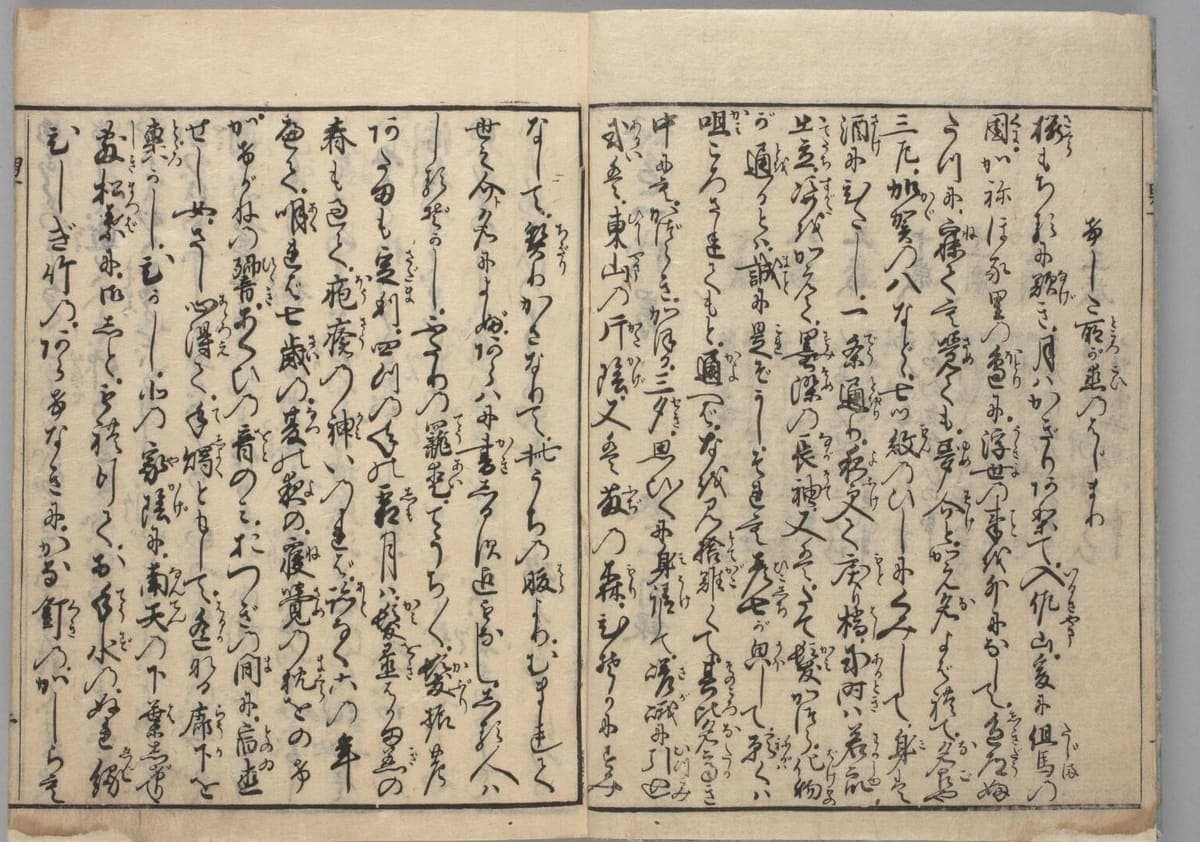
National Institute of Japanese Literature, NIJL 200003076, 1682 · Source · CC BY-SA 4.0 · Dataset of Pre-Modern Japanese Text (NIJL), distributed by CODH
Evidano Transcription
けした所が恋のはじまり
桜もちるに歎き。月ハかぎりありて入佐山。爰に但馬の
國かねほる[?]里の邊に。浮世の事を外になして。色道[?]
ふたつに寝ても覚ても夢介と替名[?]よばれて[?]名古屋[?]
三左。加賀の八などと。七つ紋のひしにくみして。身ハ[?]
酒にひたし。一条通。夜更て戻り橋。或時ハ若衆
出立。姿をかへて[?]墨染の長袖。又ハたて髪かづら[?]。化物
が通るとハ誠に是ぞかし。それも[?]彦七が顔して。願くハ
噛ころされてもと通へバ[illegible]捨難くて。其比名高き
中にも。かづらき。かほる。三夕。思ひ〳〵[?]に身請して。嵯峨に引込
或ハ東山の片陰。又ハ[?]藤の森。[rest of line illegible]
なして。契かさなりて。此[?]うちの腹よりむまれて
世之介と名によぶ。あらはに書しるす迄もなし。しる人ハ
[remaining lines of the left page not transcribed: uncertain at this resolution]
[furigana glosses not transcribed]
Generated by Evidano’s advanced model; not yet checked against a published edition.
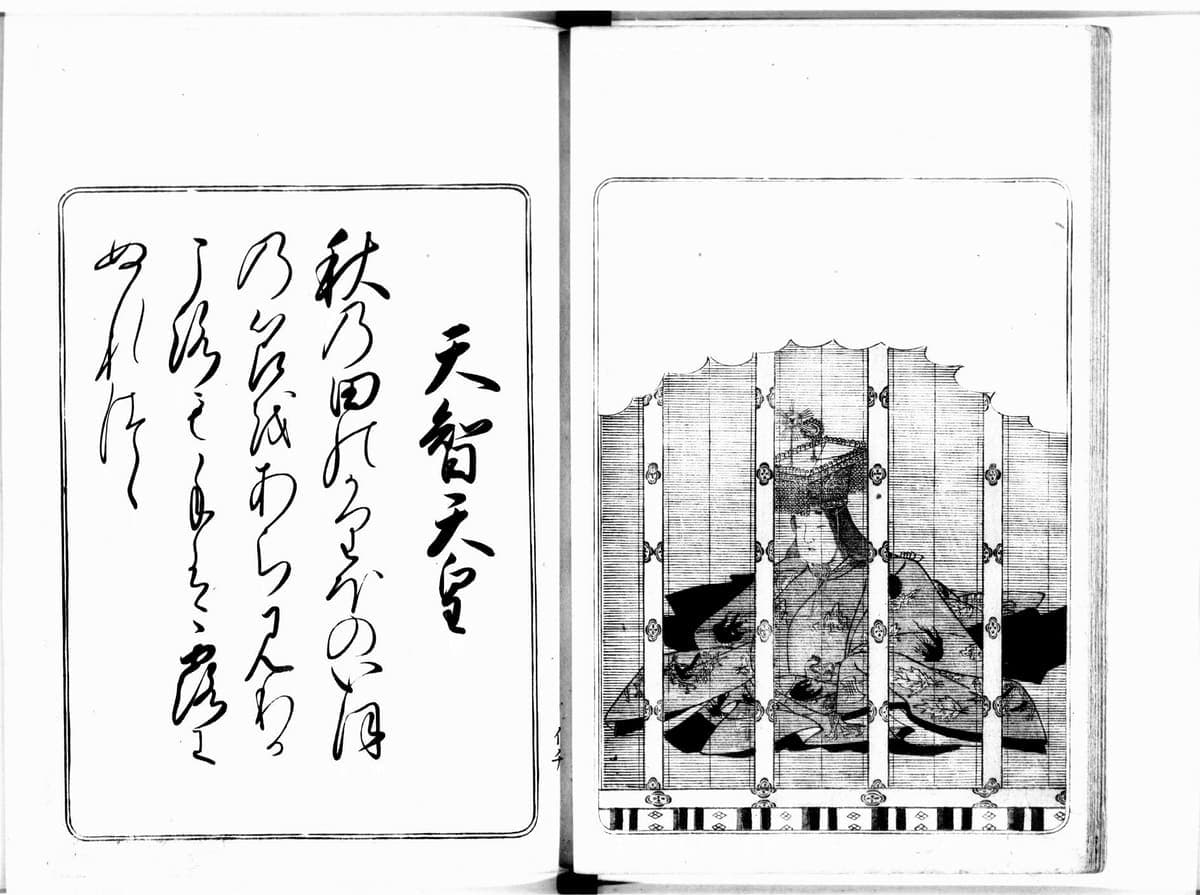
National Institute of Japanese Literature, NIJL 200007766, 1775 · Source · CC BY-SA 4.0 · Dataset of Pre-Modern Japanese Text (NIJL), distributed by CODH
Evidano Transcription
The cartouche on the left-hand page: the heading 天智天皇 and poem 1 of the Ogura hyakunin isshu, in the modern-kana text of the anthology on Japanese Wikisource, laid out in its five metrical units. The print writes the syllables in variant kana and runs them on without the line break shown here.
天智天皇
秋の田の かりほの庵の とまをあらみ
わが衣手は 露にぬれつつ
Source: 小倉百人一首, poem 1, via Japanese Wikisource (Public domain).
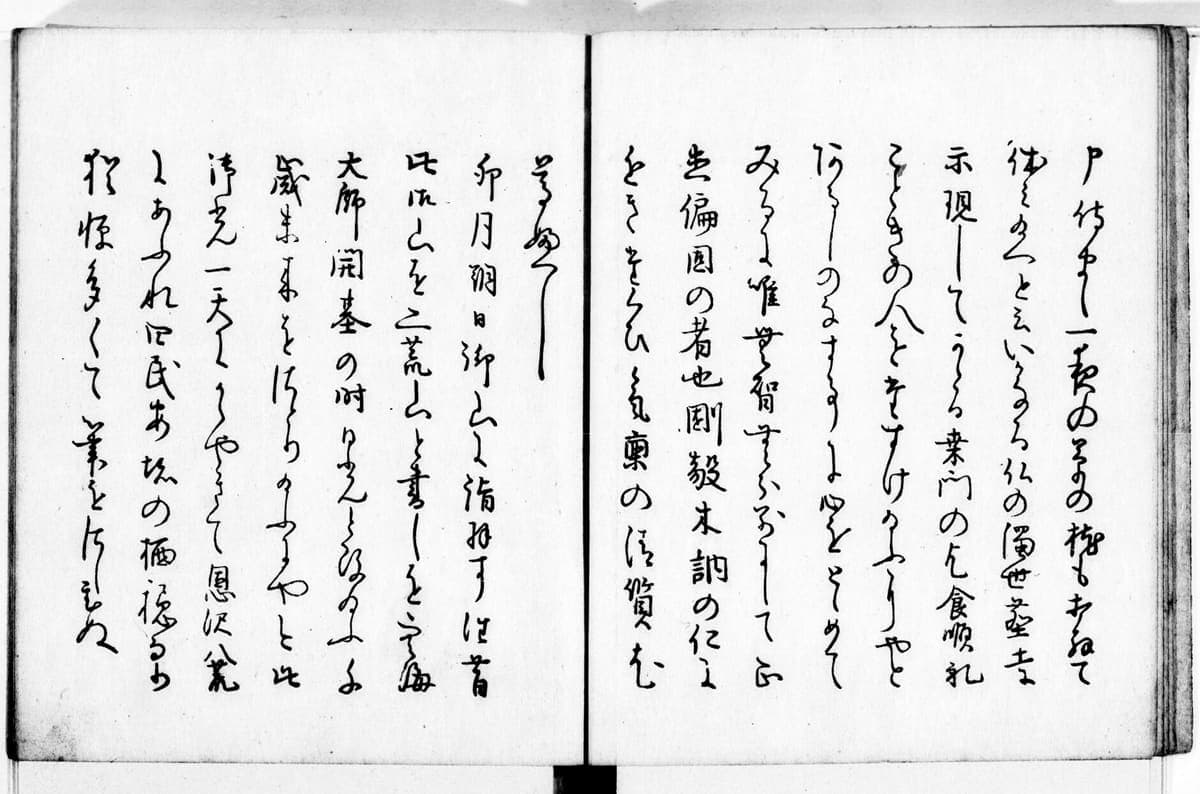
National Institute of Japanese Literature, NIJL 200008248, 1789 · Source · CC BY-SA 4.0 · Dataset of Pre-Modern Japanese Text (NIJL), distributed by CODH
Evidano Transcription
Both pages, from まゝ一夜の at the top right to 筆をさし置ぬ at the foot of the left-hand page, in the unpunctuated text on Japanese Wikisource taken from Miyake Kuniyoshi’s Shinshaku Oku no hosomichi (1911). That text prints variant readings from other witnesses in its notes; this 1789 block differs from it in small readings, and the paragraph break below is editorial.
まゝ一夜の草の枕もうちとけて休み給へと云ふいかなる佛の濁世塵土に示現してかゝる桑門の乞食順禮ごとき人をたすけ給ふにやと主のなすことに心をとめてみるにたゞ無智無分別にして正直偏固のものなり剛毅木訥の仁に近きたぐひ氣稟の淸質尤尊ぶべし
卯月朔日御山に詣拜す徃昔此御山を二荒山とかきしを空海大師開基の時日光と改給ふも千歲未來をさとり給ふにや今此御光一天にかゞやきて恩澤八荒にあふれ國民安堵の栖穩かなり猶憚多くて筆をさし置ぬ
Source: おくのほそ道, ed. Miyake Kuniyoshi, Shinshaku Oku no hosomichi (Momiyama Shoten, 1911), via Japanese Wikisource (Public domain).
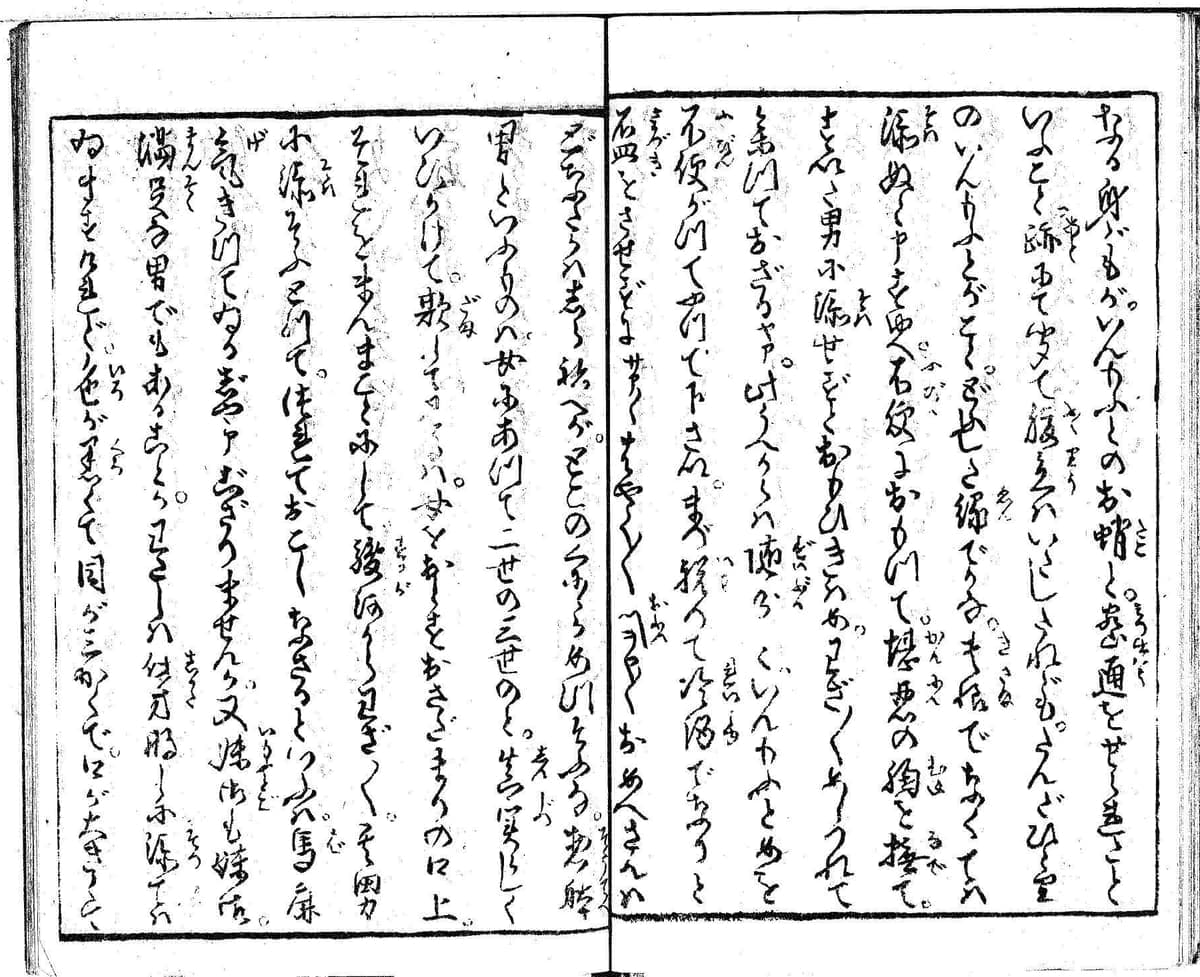
National Institute of Japanese Literature, NIJL 200004002, first published from 1802 · Source · CC BY-SA 4.0 · Dataset of Pre-Modern Japanese Text (NIJL), distributed by CODH
Evidano Transcription
する身がもがいんかふしのお蛸(たこ)と密通をせし事と
いよ/\跡[illegible]
[remaining lines illegible]
[illegible]
男とふたりのハ[illegible]二世の三世のと[illegible]
[remaining lines illegible]
Generated by Evidano’s advanced model; not yet checked against a published edition.
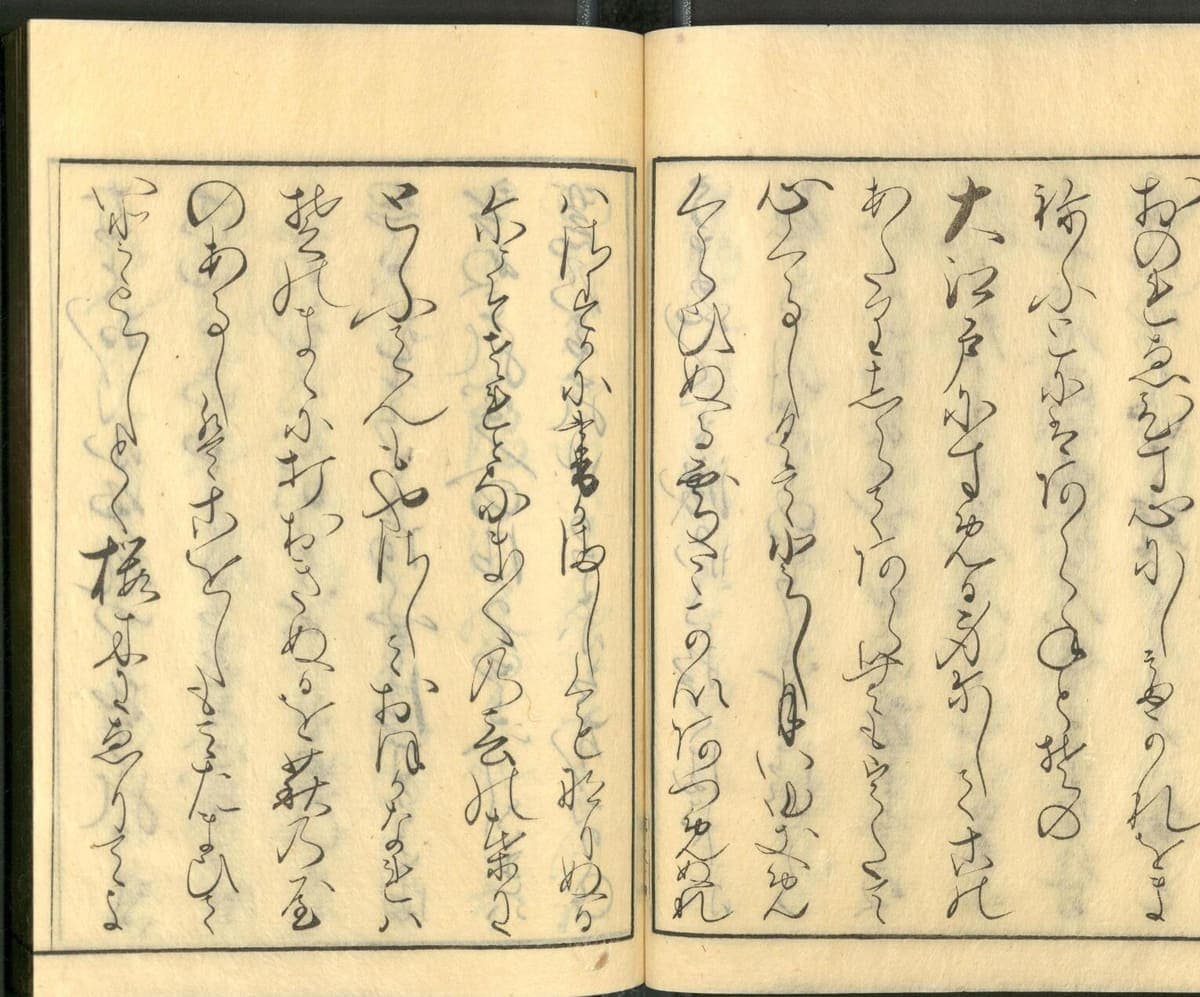
National Institute of Japanese Literature, NIJL 100249896, 1834–36 · Source · CC BY-SA 4.0 · Dataset of Pre-Modern Japanese Text (NIJL), distributed by CODH
How a woodblock page is put together
From the seventeenth century Japan printed millions of books from carved cherry blocks, one block to an opening. Because the block was cut from a calligrapher’s fair copy, the printed line keeps the writer’s ligatures, the sloping baseline of a column, and the whole repertoire of variant kana — the shapes now called hentaigana, one syllable written from several different source characters. A single page of a novel can use three shapes for ka and two for shi, chosen for the look of the column, and the printed page therefore poses much the same recognition problem as a manuscript with one difference: the same block prints the same shape thousands of times, so an error in reading it repeats through the whole edition.
Around the main column sit several other kinds of text. Furigana, a small kana gloss giving the reading, runs down the right side of a kanji and is set at half size or less; in popular fiction almost every kanji carries one, and the gloss may give a colloquial word rather than the character’s dictionary reading. Chinese prefaces are printed with return marks and small katakana endings so that they can be read aloud in Japanese. The centre fold of each sheet carries the hashira: the book’s short title, the volume and the leaf number, printed sideways relative to the text. Publisher marks, censor seals and the colophon at the end of the last volume carry the date and the shop.
Illustration is not separate from text. In a gazetteer a caption is fitted into the sky above a temple roof; in comic fiction the speech of each figure is written into the space beside them, so that reading order follows the picture rather than a column grid. Printing itself leaves traces to interpret: ink spread where a block was over-inked, broken strokes where it wore, thin paper letting the reverse show through, and later owners’ notes brushed into the margins of a printed page in an entirely different hand.
Why ordinary OCR struggles here
Several printed shapes for one syllable
A model trained on modern Japanese type has never seen the kana derived from 志, 者 or 曾. It will either refuse them or map them to whatever modern kana they most resemble, which produces text that scans as Japanese and is wrong in a way a spellchecker cannot catch.
Main text and gloss at two sizes
Furigana sits so close to the character it glosses that ordinary line-finding merges the two streams, giving a column in which reading and word alternate. Keeping them apart, and attaching each gloss to the right kanji, is a layout problem before it is a recognition problem.
Reading order set by the picture
When text is fitted around an illustration there is no column grid to follow. Blocks have to be ordered by where they sit in the scene and who is speaking, and a transcription that simply reads right to left across the sheet will interleave two speeches into nonsense.
Worn blocks, ink spread and show-through
Late impressions lose hairlines, heavy inking fills the counters of dense characters, and thin paper shows the reverse of the leaf. All three change the shape of a character without changing the text, so the reading has to be made from the whole word rather than from the outline of one glyph.
Who works with this material
Editors of early modern literature
Anyone preparing a text of a novel, a play or a haikai collection has to work from the block-printed editions and record where impressions differ. A first pass that keeps the variant kana as written lets those differences be found by search rather than by re-reading every copy.
Libraries digitising rare book collections
A scanned volume without text is unsearchable. Catalogue departments need the colophon, the hashira title and the leaf numbers captured reliably so that scattered volumes of a set can be matched, even where the body text is only a draft reading.
Historians using gazetteers and guidebooks
Meisho zue, road guides and directories record place names, shrine dedications and distances that appear nowhere else. Researchers need the captions fitted into the illustrations transcribed along with the running text, and each one tied to the place it labels.
Print and publishing historians
Publisher marks, censor seals, advertisement pages and the dated colophon are the evidence for how a title moved between shops and how often it was reissued. They are small, they sit at the edge of the sheet, and they are exactly what a general-purpose reader skips.
Getting the best transcription
Ask for furigana as a parallel field
Request the main line and the gloss separately, with each gloss keyed to the kanji it sits beside. You then have a clean text for searching and a record of how a nineteenth-century reader was told to pronounce the word, which is often not the modern reading.
Describe the page before you transcribe it
For an illustrated sheet, ask first for a list of the text blocks and where they sit, then for the transcription in the order you agree. Settling the reading order as its own step avoids a transcription that is right character by character and useless as a text.
Say what to do with the hashira and the frame
Decide whether the centre-fold title and leaf number, the border rules and the marginal headings should be transcribed, listed separately or ignored. For a page-level index they are the most valuable thing on the sheet; inside a running text they are an interruption.
Test a late impression as well as a clean one
Run one page from a worn or heavily inked copy before the rest of the volume. If filled-in strokes and show-through from the reverse are handled there, the crisp early impressions will need almost no correction.
Further reading on this hand
The palaeography guides the in-app selector points to for this domain, if you want to check a transcription against the standard references.
- Kuzushiji (Japanese Cursive Characters)
This National Diet Library guide collects authoritative tools for deciphering kuzushiji in manuscripts and early Japanese printed books. It supplies hentaigana charts, links historical kana to their source characters, and identifies searchable dictionaries and character databases. The resource also points to fonts and learning materials that reproduce forms no longer used in ordinary modern writing. It is particularly useful for Edo woodblock books, whose carved lettering preserves brush-style cursive and numerous hentaigana.
Frequently asked questions
- Is printed kuzushiji easier than handwriting?
- A little, because a block repeats the same shape exactly and the columns are ruled. It is not easier in kind: the shapes being repeated are still cursive and still drawn from the old kana repertoire, so a reader trained only on modern type gains nothing from the regularity.
- How are the variant kana handled in the output?
- They are read as the syllable they stand for, and you can ask for the source character to be recorded alongside. Open resources such as the Kuzushiji-MNIST project, released under a Creative Commons Attribution-ShareAlike licence, catalogue these variants and are a good reference when checking a doubtful shape.
- Can the furigana be dropped instead of transcribed?
- Yes. Say so in the prompt and the gloss is skipped, which suits a plain reading text. Keep it if you are studying vocabulary or pronunciation, because the gloss often records a spoken word quite different from the characters it explains.
- What about the seals and the colophon?
- Publisher marks, censor seals and the dated colophon are read as their own items rather than as part of the text, with their position on the sheet noted. Where a seal is too worn to read it is marked as present and illegible rather than guessed from the usual formula.
- Does it distinguish the printed text from a reader’s annotations?
- It can, and it is worth asking for. Brushed notes, corrections and ownership inscriptions added to a printed page differ in ink, size and hand, and separating them keeps the edition’s text clean while preserving the evidence of who used the book.
Related scripts and pages
Transcribe your Edo printed books
Upload an opening from a woodblock volume, choose Edo-Period Woodblock Print and Hentaigana, and settle the furigana and reading-order rules on one page first.